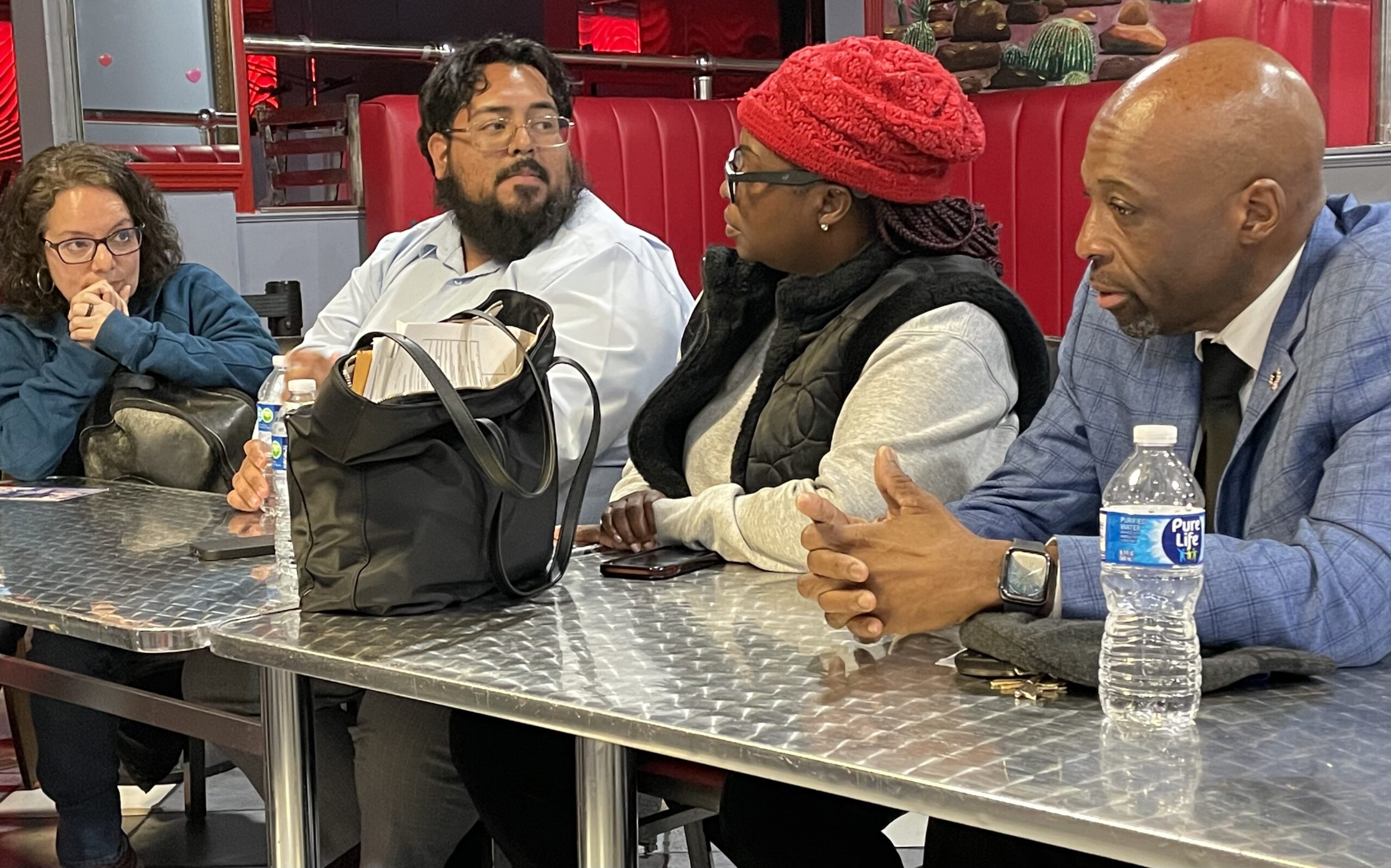
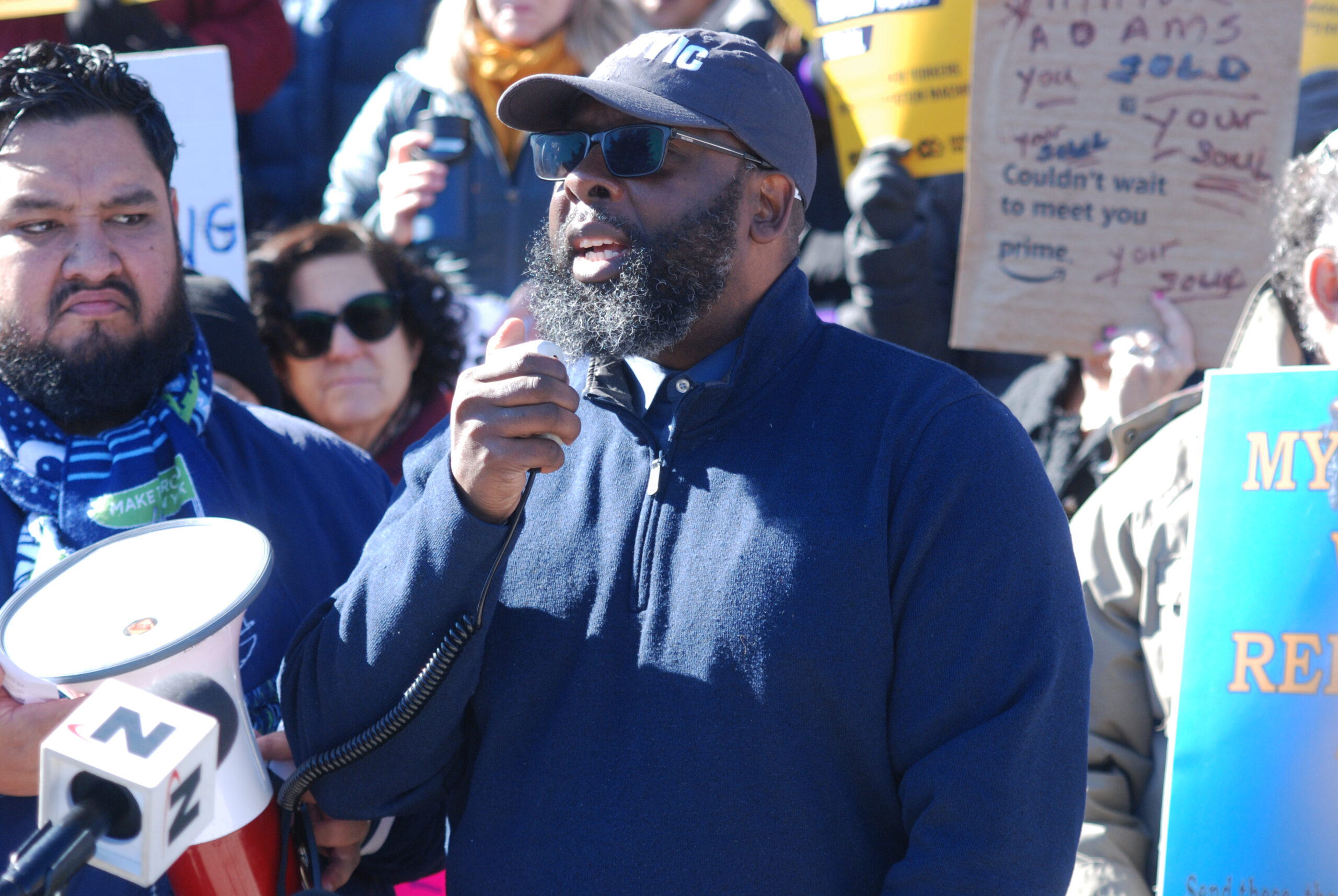
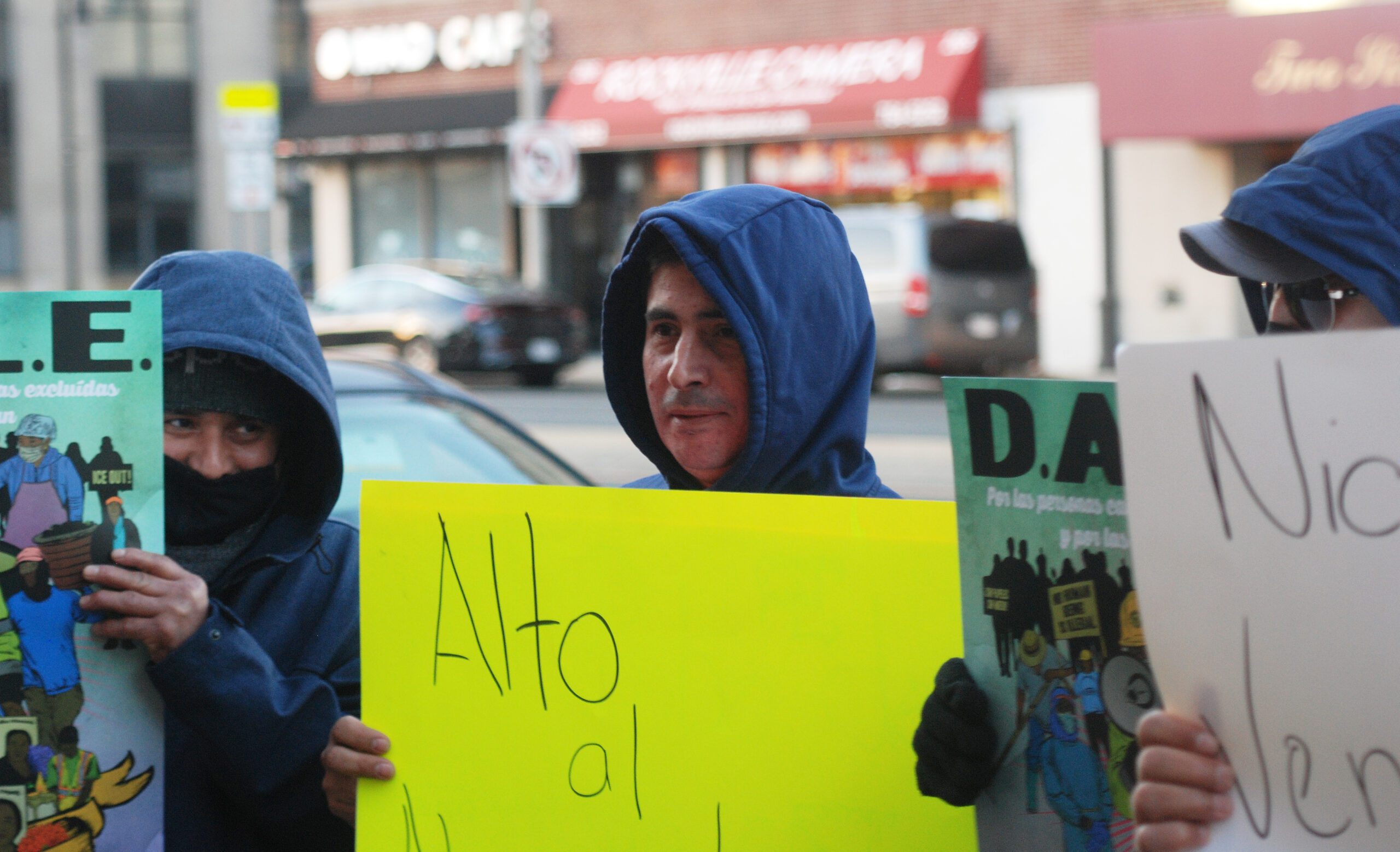
Village of Hempstead mayoral candidate Kevin Boone, far right, addressed the question of whether he would support a measure to prohibit the village from cooperating with Immigration and Customs Enforcement during a recent meeting with Hempstead-area immigrant activists. With his fellow ticket members Kevin Ramirez and Clariona Griffith, second and third from left, Boone pledged to support such a measure if he were elected. He, along with Ramirez and Griffith, were defeated in Tuesday’s village election, however. To the far left was Nadia Marin-Molina, co-executive director of the National Day Laborer Organizing Network. // Photo by Scott Brinton/Long Island Advocate
By Scott Brinton
The re-election of Hempstead Mayor Waylyn Hobbs Jr. over challenger Kevin Boone leaves open a question of whether the village will cooperate with federal Immigration and Customs Enforcement officers as they seek to carry out President Trump’s executive orders calling for mass detention and deportation of undocumented immigrants.
Boone, who lost his trustee seat in running for the mayoralty, had pledged during a meeting with Hempstead-area immigrant activists in the week leading to the March 18 election that he would, if elected, sign an ordinance prohibiting village cooperation with ICE.
Boone’s statement came in response to a question by Nadia Marin-Molina, co-executive director of the National Day Laborer Organizing Network. She asked whether Boone would allow the Hempstead Village Police Department to collaborate with ICE in detaining undocumented immigrants. She noted the village had no written policy prohibiting such cooperation.
Under current policy, Marin-Molina said, “any individual police officer can call immigration.”
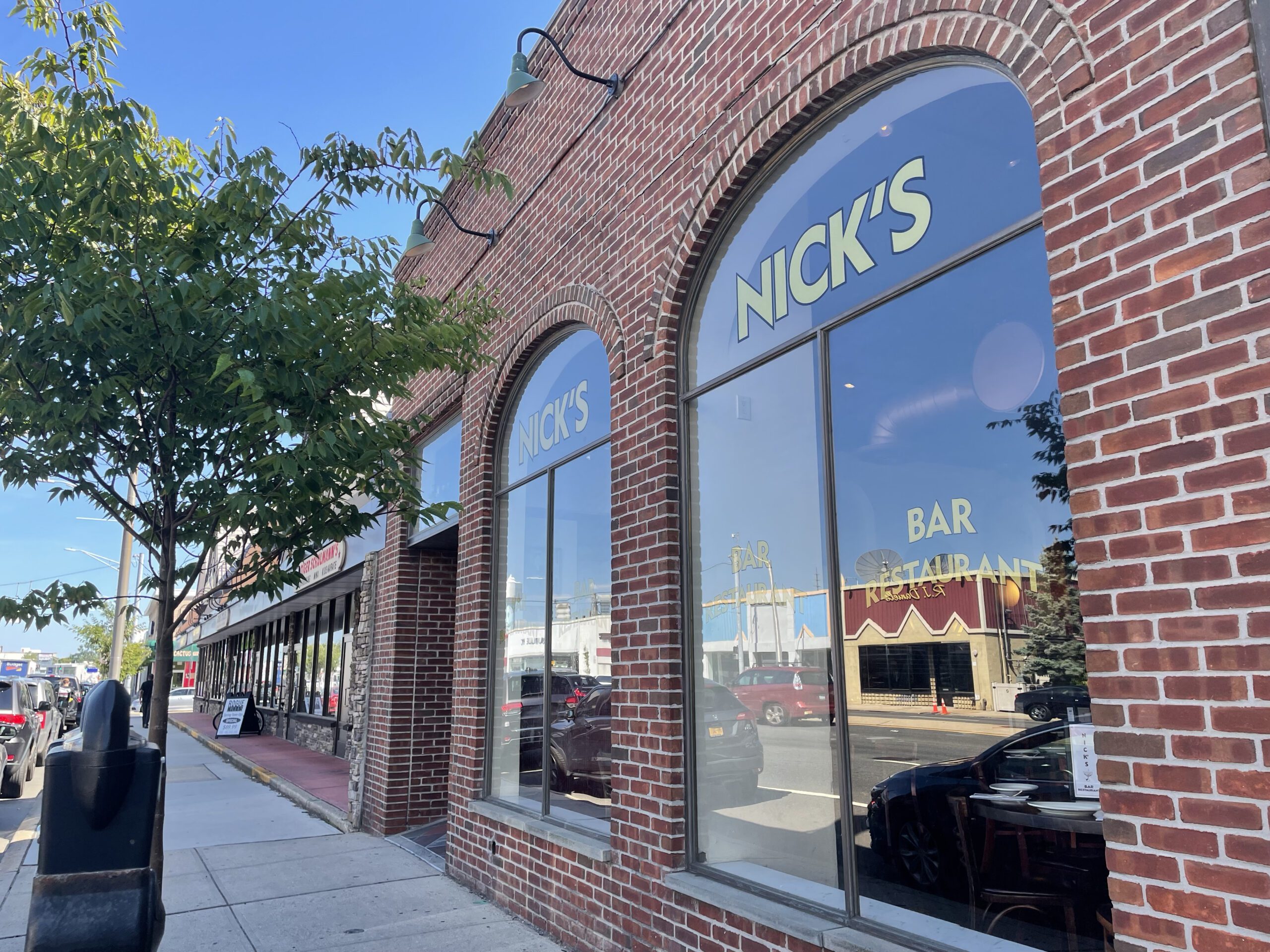
Boone ran on the People Over Party United ticket with incumbent Trustee Clariona Griffith and newcomer Kevin Ramirez. They joined him at the meeting with the activists, held at a bar/restaurant in downtown Hempstead. The Long Island Advocate sat in on the session.
“Everybody should be treated fairly,” Boone said. “We don’t feel anyone should be targeted, especially by the police. The police are there to serve and protect in ways that are not harassing.”
Three votes would be needed on the five-member Hempstead Village Board to pass an ordinance prohibiting ICE cooperation. Election of Boone’s three-member ticket would have ensured that the measure would have received a hearing at village hall and likely would have passed, as Griffith and Ramirez had also pledged to vote for such an ordinance.
Like Boone, Griffith and Ramirez were defeated in Tuesday’s election, losing to challengers Tanya Carter and William Whitaker.
Two phone calls to Hobbs’s office seeking comment on the question of potential ICE cooperation, one before the election and one after, were not returned.
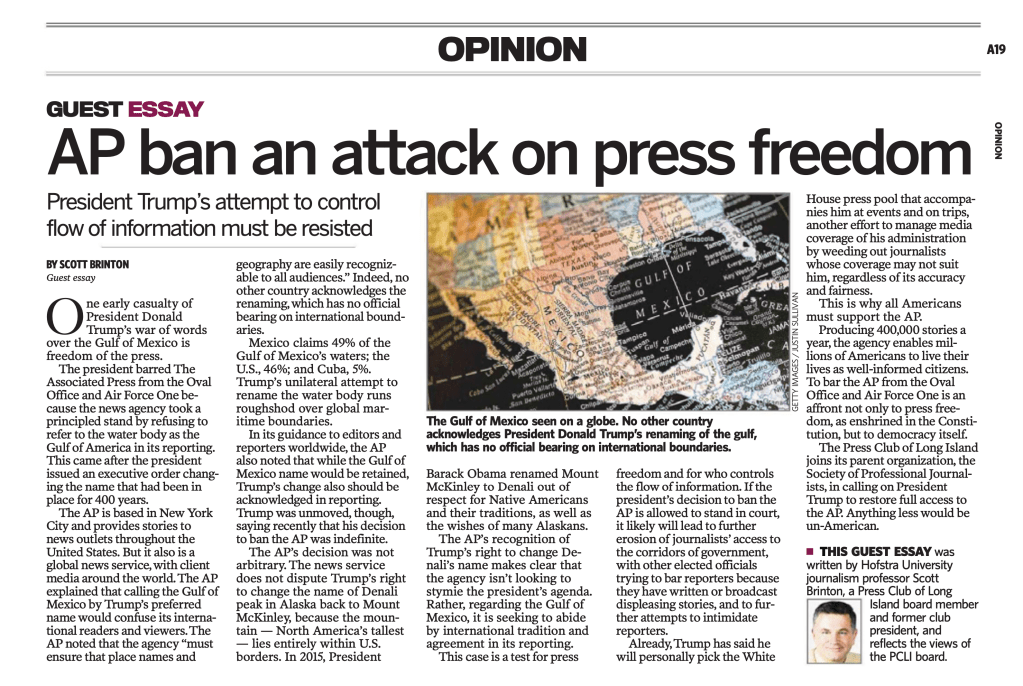
One early casualty of President Donald Trump’s war of words over the Gulf of Mexico is freedom of the press.
The president barred The Associated Press from the Oval Office and Air Force One because the news agency took a principled stand by refusing to refer to the water body as the Gulf of America in its reporting. This came after the president issued an executive order changing the name that had been in place for 400 years.
The AP is based in New York City and provides stories to news outlets throughout the United States. But it also is a global news service, with client media around the world. The AP explained that calling the Gulf of Mexico by Trump’s preferred name would confuse its international readers and viewers. The AP noted that the agency “must ensure that place names and geography are easily recognizable to all audiences.” Indeed, no other country acknowledges the renaming, which has no official bearing on international boundaries.
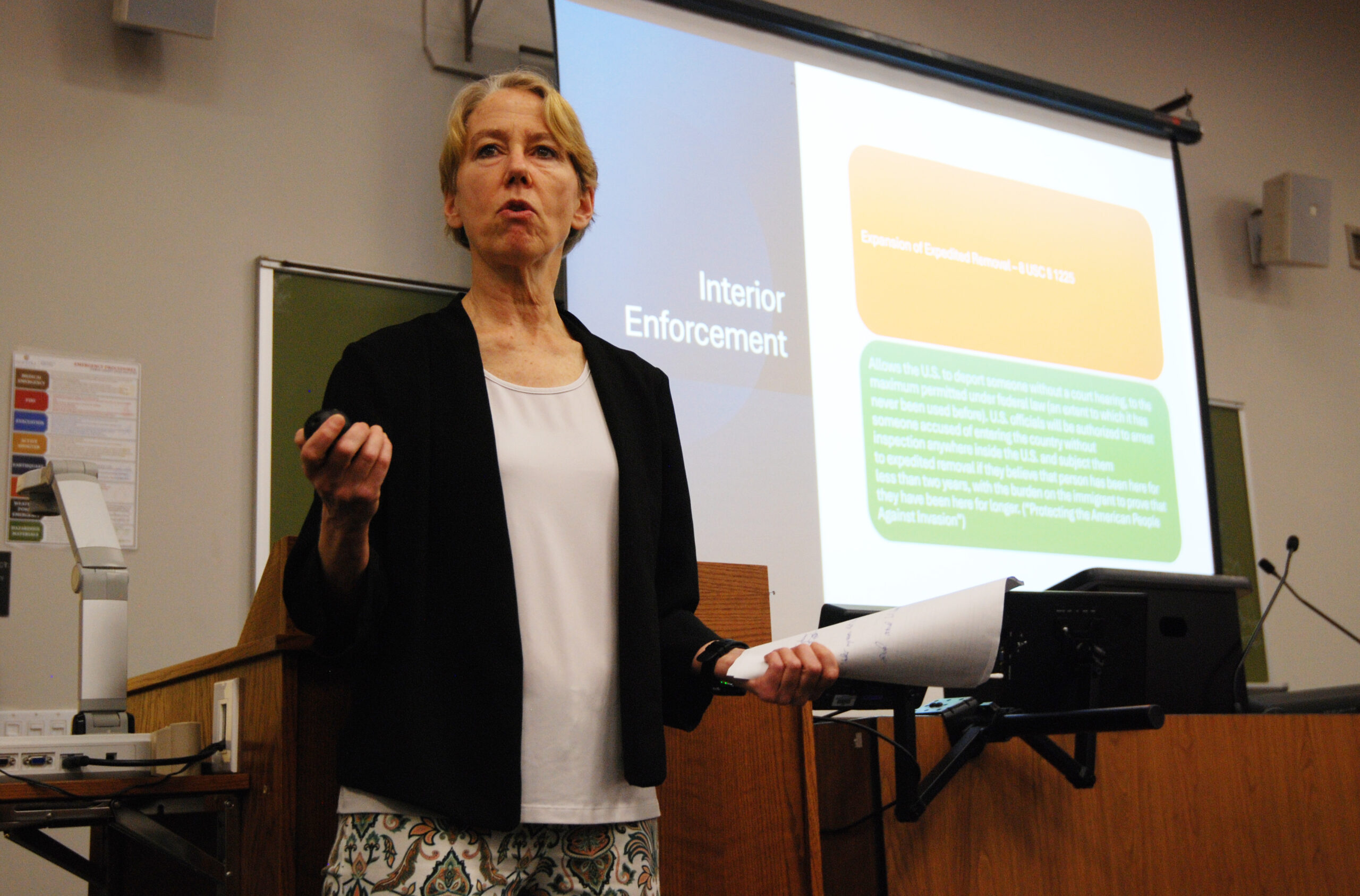
Lauris Wren discussed Trump’s new immigration policies, including the potential impact of expedited removals and how the media is increasing fear around immigration. // Photo by Scott Brinton/Long Island Advocate
By Melinda Rolls
The Trump administration has moved swiftly to carry out a series of executive orders on immigration that are intended to crack down on illegal immigration and secure the border. Those orders, though, may be more about instilling fear in immigrants to force them out of the country rather than using Immigration and Customs Enforcement to remove them.
That’s the take of Lauris Wren, clinical law professor at Hofstra University and director of its asylum clinic. She examined Trump’s immigration strategy during a talk at Hofstra’s Maurice A. Deane School of Law Feb. 25.
Expedited removals
Wren said she and other immigration attorneys are most concerned about the administration’s plan to expand the use of expedited removals. Expedited removal allows low-level immigration officers to rapidly deport undocumented non-citizens if they cannot prove they have been in the U.S. for more than two years. An exception is made for individuals who express fear of returning to their home country, granting them the right to determine their eligibility to apply for asylum in the U.S.
Wren said her concern lies in the rapid process, which may lead to unjustified deportations. Because of the swiftness of expedited removals without additional legal oversight, detainees may be unable to prove they do not meet the criteria for expedited removal.
“Any of these procedures where there is not traditional or other reliable oversight are very worrisome to civil right advocates,” Wren said.
Flourish graphic by Melinda Rolls/Long Island Advocate
My first Spanish-language bylined story!! Thank you to the Hempstead-based La Tribuna Hispana!!
La protesta del 14 de febrero frente al edificio del gobierno de Nassau pretendía, en parte, mostrar amor por la comunidad inmigrante, según la Unión de Libertades Civiles de Nueva York. Foto: Long Island Advocate
Sergio Jiménez, de Amityville, activista de una coalición por los derechos de los inmigrantes que incluye el Workplace Project en Hempstead, fue abordado recientemente por un conocido con una propuesta inusual: El hombre, un inmigrante hondureño, le preguntó si Jiménez quería comprar su auto.
Por Scott Brinton / LI Advocate
El hondureño estaba harto del trato del gobierno de Trump a la comunidad inmigrante y planeaba regresar a su país de origen. Necesitaba que alguien le comprara su vehículo, en lugar de abandonarlo. «Se vuelve a Honduras porque no soporta tanta represión», dijo Jiménez. Jiménez habló durante un conversatorio de casi dos horas, que The Advocate celebró el miércoles 5 de febrero en un restaurante, en la Villa de Hempstead, a la que asistieron 15 inmigrantes y defensores de la comunidad local y más allá. Vinieron a discutir el cambio en la política de inmigración del presidente Trump, sobre las redadas y deportación de inmigrantes indocumentados.
Ignorando el impacto económico Trump, dijo Jiménez, está ignorando el potencial impacto económico de decenas de miles, tal vez millones, de inmigrantes indocumentados que regresen a sus países de origen, ya sea porque se ven obligados o porque deciden hacerlo por su cuenta. Si un número creciente de inmigrantes se marcha, la economía decaerá, señaló. Los inmigrantes constituyen un tercio de la mano de obra del condado de Nassau y un tercio de los propietarios de pequeñas empresas, y los inmigrantes de Nueva York, documentados e indocumentados, pagan más de $3,100 millones anuales en impuestos estatales y locales, según la Coalición de Inmigración de Nueva York.
«Hacer miserable la vida de la gente» Nadia Marín-Molina, codirectora ejecutiva de la Red Nacional de Organización de Jornaleros, con oficina en el Centro de Justicia para Trabajadores de Freeport, dijo creer que el gobierno de Trump tiene como objetivo «hacer miserable la vida de la gente, asustarla y aterrorizarla para que se vayan ellos mismos, porque no pueden deportar a todos los que dicen que van a deportar.» Hasta el 3 de febrero, el Departamento de Seguridad Nacional de Estados Unidos informó de casi 8,800 detenciones de inmigrantes, con casi 5,700 deportaciones y expulsiones desde que Trump asumió el cargo. Los arrestados representaban a 121 países. El 2022, se estimaba que 11 millones de inmigrantes indocumentados vivían en Estados Unidos, el 3% de la población, según el Consejo Estadounidense de Inmigración.
Angel Reyes, 35, of Glen Cove, a coordinator with the immigrant rights organization Make the Road in Brentwood, served as the primary speaker throughout the hour-long protest outside the Nassau County Legislature. // Photo by Scott Brinton/Long Island Advocate
County Executive Blakeman emphasizes only known criminals would be detained
By Gabriel Prevots
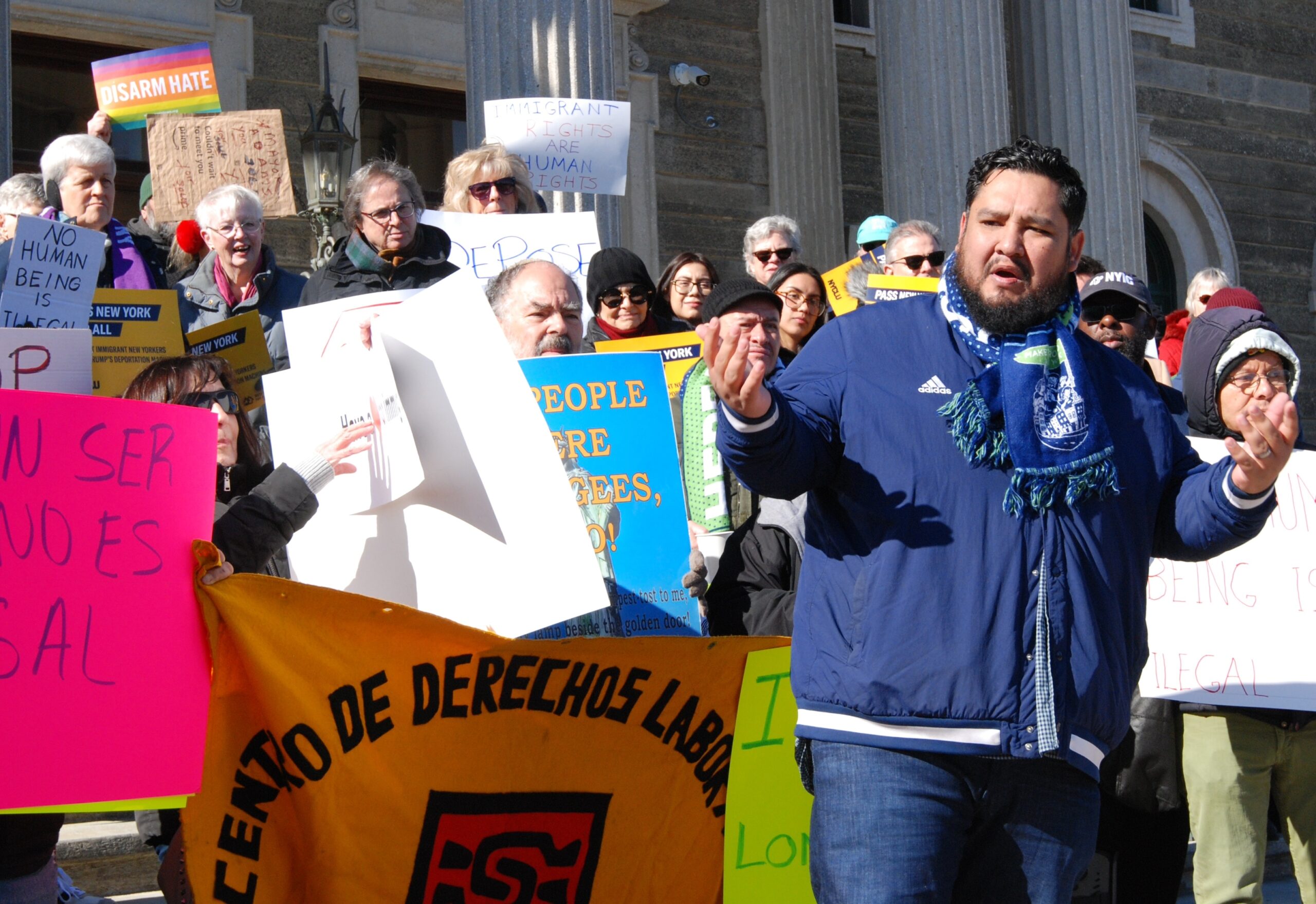
More than a hundred protesters gathered on the steps of the Nassau County’s Theodore Roosevelt Executive and Legislative Building Friday to denounce County Executive Bruce Blakeman’s announcement that 10 county police detectives will be deputized to work with Immigration and Customs Enforcement.
Between chants in English and Spanish supporting immigrants, prominent representatives from immigrant rights advocacy groups, elected leaders and union members called on Blakeman to rescind his Feb. 5 decision and urged their communities to show solidarity with immigrants.
Robert Agyemang, of Hempstead, vice president of the New York Immigration Coalition, speaking at the protest. // Photo by Scott Brinton/Long Island Advocate
Immigrants “are the bedrock of every community in this state and in this country, and under no circumstances should the state law enforcement or city law enforcement or municipal law enforcement be colluding with ICE,” said Robert Agyemang, of Hempstead, vice president of the New York Immigration Coalition. Agyemang was born in the U.S., and his parents emigrated from Ghana.
“We’re here today, we’re sending the message: Blakeman, you need to do the right thing. You still have time to make it up,” said Angel Reyes, of Glen Cove, Long Island coordinator with the immigrant rights organization Make the Road in Brentwood, who served as emcee for the hour-long protest.
In response to opposition to his announcement, Blakeman reaffirmed that the purpose of the deputized detectives would be “picking up criminals, people who are engaged in crimes … These aren’t going to be raids. These are going to be targeted enforcement of known criminals who are here illegally.”
It is unclear when Blakeman’s deputization of the county detectives will take place, as the details have not yet been made public. ICE collaborations with police departments under its 287(g) program are published on the agency’s website, and as of Feb. 16, Nassau County remained absent from the list.
Still, speakers emphasized that ICE’s current enforcement policies, laid out by President Trump, have had a chilling effect on immigrant communities throughout Long Island, instilling anxiety and fear and leading many to forgo help when they need it most.
Marcia Estrada, a chapter coordinator with local women’s and immigrants’ rights organizations, shared her personal story of escaping “abuse, poverty and threats to my life” in Honduras and then domestic abuse in the United States.
Referring to the abuse, Estrada said, “If this had happened today with the police collaborating with ICE, I would have never sought help. I would have never called the police because I would have feared facing deportation, being separated from my children or even facing death.”
Dozens of protesters convened on the legislature’s steps to decry County Executive Bruce Blakeman’s recent policy to deputize police detectives to work with the federal Immigration and Customs Enforcement. // Photo by Scott Brinton/Long Island Advocate
According to the New York Civil Liberties Union, the Feb. 14 protest was held on Valentine’s Day to “demonstrate love and support for Long Island immigrants, many of whom are living in fear due to an escalation in ICE activity in their communities.”
An increasing number of immigrants are considering returning to their home countries because of the Trump administration’s “suppression” of immigrant rights, according to Hempstead area activists. Last week, 15 immigrants and advocates gathered to discuss with The Advocate. // Photo by Scott Brinton/Long Island Advocate
By Scott Brinton
Sergio Jimenez, of Amityville, an activist with an immigrant rights coalition that includes the Workplace Project in Hempstead, was recently approached by an acquaintance with an unusual proposition: The man asked whether Jimenez would take over his car payments.
The Honduran man had had enough of the Trump administration’s treatment of the immigrant community and planned to return to his home country. He needed someone to assume his car payments rather than abandon the vehicle.
“He’s going back to Honduras because he can’t stand all this suppression,” Jimenez said.
Jimenez spoke during a nearly two-hour conversation that The Advocate held last Wednesday at a restaurant down the street from Hempstead Town Hall, attended by 15 immigrants and advocates from the local community and beyond. They came to discuss President Trump’s immigration policy shift, with its increased focus on identifying and deporting undocumented immigrants.
The Advocate is not naming the restaurant to protect the privacy of its ownership.
Trump, Jimenez said, is ignoring the potential economic impact of tens of thousands, perhaps millions, of undocumented and documented immigrants returning to their home countries, either because they are forced or they choose to. If a growing number of immigrants leave, the economy will decline, he noted.
Immigrants comprise a third of Nassau County’s workforce and a third of its small business owners, and New York’s immigrants, documented and undocumented, pay more than $3.1 billion annually in state and local taxes, according to the New York Immigration Coalition.
Nadia Marin-Molina, co-executive director of the National Day Laborer Organizing Network, with an office at the Freeport Workers Justice Center, said she believes the Trump administration aims to “make people’s lives miserable and to scare people, to terrorize people into leaving themselves, because they can’t deport everybody that they say they’re going to deport.”
Zach Hunter, of Hempstead, a student at Academy Charter, led his school’s cheerleading squad in Saturday’s Hempstead-Hofstra MLK Day Parade and Celebration, “Moving Forward: The Dream Realized.” // Photo by Scott Brinton/Long Island Advocate
By Scott Brinton
I was honored to cover the 2025 Hempstead-Hofstra MLK Day Parade and Celebration. Here’s my Long Island Advocate report:
Dressed in a dark purple suit, her hands flowing excitedly and her voice booming through the Hofstra University Student Center on Saturday, Dr. LaQuetta Solomon, clinical psychotherapist and emotional intelligence assessor, declared, “Our existence today is the dream realized. It’s the dream realized that I’m standing here speaking to you.”
The dream that Solomon was referring to was Dr. Martin Luther King Jr.’s vision for America, the hope and belief that people of all races and creeds would one day live as one, with equal opportunity for all.
Solomon served as the keynote speaker for “Moving Forward: The Dream Realized,” a celebration of Dr. King’s life and work held Saturday in remembrance of his upcoming birthday, Jan. 15. The four-hour event, a collaboration between the Village of Hempstead and Hofstra University, included a parade from Hempstead Village Hall to Hofstra’s North Campus and a cultural program that included song and dance performed by students from the Academy Charter School and Hempstead High School, as well as the Youth and Teens Dance Company in Hempstead.
MLK Day, a federal holiday, is marked annually on the third Monday of January. This year, it falls on Jan. 20, Inauguration Day.
Phyllis Young, a founder of Miracle Christian Center in Hempstead, was among the marchers carrying oversized photos of Dr. Martin Luther King Jr. during Saturday’s parade on Hempstead Turnpike through the Village of Hempstead, which was followed by a morning of cultural programming and discussions on King’s life and legacy. Young’s daughter, Dr. Jacqueline Gates, MCC’s senior pastor, served as a co-grand marshal of the parade with Hofstra President Dr. Susan Poser. // Photo by Scott Brinton/Long Island Advocate
Other participants in the celebration included Aviation High School in Long Island City, the United People’s Organization, Uniondale-Hempstead Girl Scout Troop 1570 and the Hofstra wrestling team, among others.
This was the 32nd year that a MLK Day parade has been held in Hempstead, and the third year that Hempstead Village and Hofstra University have teamed up to celebrate Dr. King. Born in Atlanta in 1929, the reverend would have been 96 this year.
Dr. Laurie Hamilton, an educational leader in the Hempstead School District, served as the host and emcee for Saturday’s cultural celebration. The day was intended, she said, to honor Dr. King’s legacy.
Dr. LaQuetta Solomon, clinical psychotherapist and emotional intelligence assessor, delivering Saturday’s keynote address, which focused on Dr. King’s dream in the present day. // Photo by Scott Brinton/Long Island Advocate
Solomon’s 28-minute talk was one part informational, one part inspirational. “It’s the dream realized that we have so many generations here coming together, learning how to work with one another, building community,” she said.
My wife, Katerina, and I over the weekend took in Stereophonic on Broadway, which follows an unnamed ’70s pop-rock band closely resembling Fleetwood Mac as it ascends up the charts and their familial and platonic bonds devolve into internecine feuding that threatens to unravel the band — just like Fleetwood Mac.
I would call it a semi-musical, full of pop-rock tunes played live that perfectly capture the sense of the rock-light anthems that Fleetwood Mac produced and inspired, but also full of drama that at times borders on madness. The show puts on full display the range of emotion, from love to hate, joy to anger and sorrow, with points of comedy for good measure. In a real sense, we see humanity play out in three hours of mock recoding sessions on a single set that assiduously mimics what one would imagine a ’70s recording studio might look like.
This show no doubt earned its Tony for Best Play. Last show is Jan. 12, so get tickets while you still can!
And of course we took in Times Square and the Rockefeller Center Christmas tree!!
My Hofstra University colleagues Mario A. Murillo, Aashish Kumar, and I last night revealed the interactive website that we’ve been working on the past year or so to graphically represent our academic study on suburban news deserts. Special thanks to Hofstra University President Susan Poser, whose office funded our research, and to our amazing coder Ali Tan Ucer!! Would love to hear your thoughts and suggestions!!
Updated Nov. 19, 2024, 8 a.m.: There is no singular, well-defined reason that Kamala Harris lost her 2024 bid for the presidency. There are many. What is clear is this: Race played a part in this year’s presidential election, whether we want to acknowledge it or not.
Harris, the first Black and South Asian woman to receive a major-party nomination for president, presented herself as an intelligent, eloquent, highly experienced candidate who ran a campaign centered on empathy and joy. Her quick wit and obvious rhetorical skills commanded the stage during the only presidential debate. A majority of Americans believed she won that debate, according to polling. Yet, America chose a White male in this year’s election, as it had done all but twice dating back to our first presidential race in 1788-89.
Vice President Kamala Harris // Official White House photo by Lawrence Jackson via Wikimedia Commons
Before Donald Trump is sworn in, all Americans should take time to reflect deeply on what this election has wrought rather than simply moving on. After 2045, when America is no longer a majority-White nation, future generations will expect answers.
Political commentators, both conservative and liberal, have echoed a consistent theme over the past week: Harris lost because of inflation. It rose too high, too fast. Too many people either stayed home or voted their pain by casting their ballots for Trump.
Many pundits contend Trump pierced or broke “the Obama coalition,” which comprised a delicate balance of White voters and overwhelming support among people of color that gave Obama his two electoral wins in 2008 and 2012. Joe Biden recreated the coalition in 2020, propelling him to the White House.
In examining this year’s exit polling data, one finds the Obama coalition frayed, but still largely intact. There is no doubt that Black, Hispanic and Asian people voted in lower numbers for Harris than Biden, according to polling, but the downward shift was small, the Associated Press reported in its election analysis.
Harris presented herself as an intelligent, eloquent, highly experienced candidate who ran a campaign centered on empathy and joy. Her quick wit and obvious rhetorical skills commanded the stage during the only presidential debate…Yet, America chose a White male in this year’s election, as it had done all but twice dating back to our first presidential race in 1788-89.
The National Election Pool, a consortium of media networks —ABC, CBS, CNN and NBC News—surveyed 20,000 voters from across the country as they left the polls. In addition, the NEP polled voters at 40 balloting locations in 10 key states—Arizona, Georgia, Florida, Michigan, Nevada, North Carolina, Ohio, Pennsylvania, Texas and Wisconsin, with 1,500 to 2,000 respondents per state. The primary purpose of the exit polling, conducted by Edison Research, was to understand election demographics.
The NEP poll in the key swing states that determined the election outcome revealed a marginal change in the Black vote—85% identified as Democrat compared to 87% in 2020—with larger shifts seen among Latino and Asian voters. According to the poll, 13% fewer Hispanic and 7% fewer Asian respondents identified as Democrat. Still, a majority within each group called themselves Democrats.
Pundits have focused on young Black men, but the NEP key state findings showed only a small drop in Democratic support within this demographic. Among Black men ages 18-29, 84% identified as Democrats, down from 89% in 2020. Meanwhile, support among Black men ages 30-44 increased, with 82% identifying as Democrats compared to 78% in the last election cycle.
The Associated Press surveyed 120,000 respondents nationwide. The AP found “Trump succeeded in locking down his traditionally older, white base of voters, and he slightly expanded his margins with other groups into a winning coalition.”
Key word: slightly.
The news media’s focus on—and doubts about—the Black vote in the weeks and days leading to the election resulted from polling that overrepresented White opinion and underrepresented the Black perspective, according a pre-election analysis by Gloria Oladipo of The Guardian.
As Chris Towler, founder of the Black Voter Project, which surveys Black people on their voting behaviors, told The Guardian, “To say that for any reason we need to worry about Black men not supporting Harris or the Democrats is completely overblown. I think a lot of the story around this need to regain Black voters is coming from a mainstream media narrative built around really poor polling on Black voters.”
White voters, the AP noted, comprise the “bulk” of the electorate in the United States, and “they did not shift their support significantly at the national level compared to 2020.” That is, a majority of White voters—55-60%—supported the Republican presidential candidate once again.
More than 80% of Trump voters were White, compared with 60% of Harris supporters. // Official White House photo by Shealah Craighead via Wikimedia Commons.
As William Frey, senior metro fellow at the nonpartisan Brookings Institution think tank, noted, the Republican Party “is hardly a multiracial coalition.”
Harris clearly understood the political force that is the White Republican vote and attempted to reach out to this voting bloc to form what is perhaps best described as a unity ticket, even campaigning with former U.S. Rep. Liz Cheney, a staunch conservative. Harris knew she needed Republican ballots to win the White House. In the end, though, she didn’t even garner a majority of suburban White women, one of the demographics whom she sought most intensely to win over throughout her campaign. According to the NEP key state poll, only 46% of suburban White women voted Democratic, while 53% went Republican.
Not all White people voted for Trump. Four in 10 did not, according to the AP. Given that White people comprise three-quarters of the electorate, however, a 10-20% deficit in the White vote is a nearly insurmountable difference without the Obama coalition fully intact and engaged.
Given how intractable the White Republican vote has traditionally been, and how large it is, winning the White House requires perfection or near perfection on the part of a Democratic presidential candidate, while the electorate has historically been more forgiving of the GOP candidate. In Trump’s case, he pushed rhetorical limits even beyond previous elections, with so much of what he said far beyond the pale of traditional electoral norms and societal and cultural mores, and he still won.
Did the economy really determine the outcome?
Polling, both before the election and after, consistently found the economy to be voters’ top issue. And no doubt, millions of people felt the strain of rising prices in recent years.
The U.S. now boasts the strongest economy among the Group of Seven major advanced economies, which include Canada, France, Germany, Italy, Japan, the United Kingdom and the U.S., as well as the European Union.
Average weekly earnings are roughly 32-37% higher for White workers than for Black and Hispanic workers, which accounts in part for why nearly two-thirds of White families owned stocks directly or indirectly in 2022, compared with 39% of Black families and 28% of Hispanic families, according to the Federal Reserve’s Survey of Consumer Finances.
This election, a majority of White Americans only needed to check their stock and retirement accounts to understand how far the economy had improved since the first two years of the Biden-Harris administration, when, it should be noted, the pandemic still raged. The S&P 500 stock market index rose 48% over the past four years. It now stands at 6,000, an historic high. This past week, the Dow Jones Industrial Average broke 44,000, also a record.
Black and Latino voters were disproportionately affected by job losses amid the pandemic and the accompanying spike in prices for food and household goods. Yet, more than 8 in 10 Black and 5 in 10 Hispanic people voted for Harris. That is, an overwhelming majority of Black people and a majority of Hispanic people turned out for the vice president — despite their economic pain.
Meanwhile, even though the Biden-Harris economy advantaged and benefitted at least two-thirds of White Americans, the vice president could not secure majority backing from this demographic.
“Exit polling numbers make it apparent that the Black vote continued to act as a stabilizing force for Democrats.”
Jovonne Ledet, Black Information Network
If just 5 in 10 White voters had cast their ballots for Harris, instead of 4 in 10, she would have been our 47thPresident.
I cannot peer into the minds of the 55-60 or so percent of White people who voted for Trump to know precisely why each of them cast their ballots as they did. This is, though, a question that requires deeper reflection and analysis by Democrats if they are to win future presidential elections, particularly given this year’s hairline cracks in the Obama coalition.
In the meantime, to the political pundits, I say this: Stop pinning Trump’s victory on young Black and Hispanic men. Flip the narrative. Why did more White people, women and men of all age groups, not vote for Harris?
This opinion piece was amended on Nov. 19, 2024, to more clearly define the difference between the NEP national and key state exit polls. Additionally, new material was added.
Scott Brinton is an assistant professor of journalism at Hofstra University’s Lawrence Herbert School of Communication in Hempstead. This commentary represents his views, and his alone. Thoughts? Connect with him on X @ScottBrinton1.
As a media observer, I found CNN’s after-action report on its Oct. 23 town hall with Vice President Kamala Harris to be a classic case of beltway elitism in which the network’s commentators, on the right and left, went to extraordinary lengths to dissect Harris’s every statement through the prism of their Acela bubble while ignoring how her messaging might or might not have resonated with voters in the audience and at home.
Anderson Cooper was his usual affable, polite self while moderating the town hall, pushing the vice president without being pushy. That is, he was fair and objective.
After, the commentators were anything but. At their worst, the Republican pundits, barely able to contain their disdain for the vice president, spewed unabashed partisan venom. Later, the commentators tried to moderate their statements and return the rhetoric to a neutral center, but they never did.
Vice President Kamala Harris addressing a crowd of supporters in Madison, Wis. in September. // Photo via Wikimedia Commons
Then, John King, the fairest of the commentators, asked five of the undecided Pennsylvania voters in the audience if they planned to vote for Harris because of the town hall. Three of the five said yes — two immediately and one during the focus group. None said they had yet decided to vote for Donald Trump.
Of the two remaining undecided voters, one said she wanted more specifics on Harris’s policy proposals, particularly on the economy, but found the vice president connected with her as a woman. The other, a Republican, said he found Harris to be respectful of his beliefs, but he could not move past her support for choice and Roe. He appreciated that the vice president approached him after the town hall to speak with him personally. That was, in part, among the reasons he had yet not decided to vote for Trump. The former president’s behavior and speech, he said, were the primary barriers.
Clearly, there was a disconnect between how the CNN commentators believed the audience perceived the town hall and how they actually did. And there you have the trouble with our national news network pundits, who too often seek to steer our political discourse by sowing doubt and confusion among voters before they can reach their own conclusions, thus exacerbating polarization within the electorate. If King had spoken with audience members before CNN turned to its usual cast of politicized commentators, then the network could have offered a more accurate assessment of how the town hall was interpreted by voters, and perhaps more nuanced commentary would have followed.
It is little wonder then that Harris chose to first project her message to the electorate in a series of rallies over the summer, attended by hundreds of thousands of voters, before turning to the national media and allowing them to frame her candidacy through Washingtonian political speak.
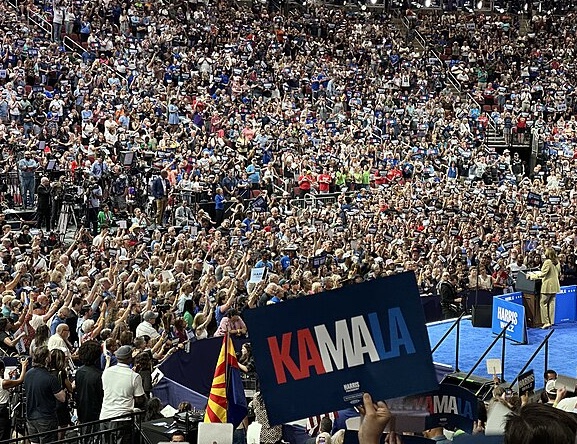
Harris campaigning in Glendale, Ariz. in August. // Photo via Wikimedia Commons
Interestingly, at one point after the town hall, Jake Tapper, trying to inject some level of journalistic objectivity into the conversation, noted the commentators were holding Harris to a different, tougher standard than they did Trump because the vice president had accepted CNN’s invitation to a debate, while Trump chose to sit this one out — thus the town hall format.
Van Jones, a Harris supporter and former Obama adviser, said the vice president was given an entirely different test than Trump, one that was markedly more difficult. To my mind, one might say Trump and Harris are taking the same exam — the presidential election — but they are graded according to different rubrics by the national network media.
Trump “gets to be lawless,” Jones said. “She has to be flawless. That’s what’s unfair.”
Click here for the X video.
At the same time, one must wonder to what degree race and gender are playing a part in our political commentary. Are the media holding Harris to a more stringent standard than they do Trump because she is a woman who is Black and South Asian and therefore outside the normative White majority paradigm of what a president should look like and how a president should behave? Are they expecting a certain impossible perfectionism, as the media and the public did with Jackie Robinson and Barack Obama? Or has Trump so normalized the outrageous and the outlandish that the national media commentators have become desensitized to it, unable to see the clear difference between Harris’s rhetoric and Trump’s? Or both?
My recommendation: Pay no heed to the network political pundits. Listen to the candidates themselves. You can easily find the two major-party candidates’ direct messaging to voters on YouTube. And read the candidates’ policy proposals.
If you are to listen to the national media, which I recommend you do, be sure to watch and listen to PBS, NPR, ABC, CBS and/or NBC in addition to or in place of the major news networks, as these organizations more often eschew partisan commentary in favor of objective reporting.
As well, listen to and read your community media, whose purpose is more often to show how the presidential candidates’ policy proposals will affect voters at the local level, while focusing on down-ballot congressional races that matter equally to the electorate. Congress, after all, is a coequal branch of our federal government.
Scott Brinton is an assistant professor of journalism at Hofstra University’s Lawrence Herbert School of Communication in Hempstead. This commentary represents his views, and his alone. Thoughts? Connect with him on X @ScottBrinton1.
Nora Dorival, an 11th grader at the nearby Academy Charter School, led the majorettes from her school as they marched from Hempstead Village Hall to Hofstra University as part of a morning-long tribute to Dr. Martin Luther King Jr. on Monday, the federal holiday marking his birth and a National Day of Service. // Photo by Scott Brinton/Long Island Advocate
By Scott Brinton
“We cannot walk alone,” Dr. Martin Luther King Jr. famously intoned in his seminal “I Have a Dream” speech, delivered on the steps to the Lincoln Memorial in Washington D.C. on Aug. 28, 1963. “And as we walk, we must make the pledge that we shall always march ahead.”
It seemed only fitting then that a Village of Hempstead-Hofstra University celebration of King’s life and legacy on Monday, Dr. Martin Luther King Jr. Day, began with a spirited march through the 31-degree weather on Hempstead Turnpike in Hempstead, with dozens of students from the nearby Academy Charter School and Aviation High School in Long Island City filling the parade’s ranks.
Cheerleaders from the Academy Charter School struck a pose on Hempstead Turnpike in front of Hofstra University. // Photo by Scott Brinton/Long Island AdvocateMajorettes flying their banners high on Hempstead Turnpike. // Photo by Scott Brinton/Long Island Advocate
The procession, led by Hempstead Mayor Waylyn Hobbs Jr., began at Hempstead Village Hall and headed a mile and a half east to Hofstra’s Mack Student Center, where more than 200 had assembled to greet the marchers.
Hempstead Mayor Waylyn Hobbs Jr., center, leading the way into Hofstra University. // Photo by Scott Brinton/Long Island AdvocateStudents from Aviation High School in Long Island City marched proudly onto the Hofstra campus. // Photo by Scott Brinton/Long Island Advocate
“Welcome, welcome, welcome, we are so glad to be able to stand here,” the event’s keynote speaker, the Rev. Curtis Brown, pastor of the Rising Star Baptist Church in Jamaica, Queens, told the crowd.
In an emotional, 20-minute speech that can only be described as spiritual, Brown spoke consistently of the need for unity, noting more than once, “Together, we win.”
To read the full article with audio and video, click here.
This past summer, I returned to Bulgaria, where I served in the U.S. Peace Corps, for the first time in 10 years. I produced this travelogue after my trip:
I immediately noticed the interlocking pattern of shadows that fell from the canopy of deciduous and evergreen trees onto the tombstones covered in brambles and wildflowers on this 85-degree Thursday. Birds hovered overhead, cackling. Otherwise, it was peaceful in this secluded corner of Sofia, the Bulgarian capital.
My wife, sister-in-law and I were at the Central Sofia Cemetery on July 6 to pay our respects to loved ones. Many Bulgarians visit the graves of their closest relatives at least once yearly to lay flowers and whisper prayers.
The Orlandovtsi Cemetery, as the graveyard is also known, is the final resting place of a number of Bulgaria’s glitterati, literati and top politicos, including its first democratically elected president after the fall of communism in 1989, Zhelyu Zhelev. The graveyard is egalitarian, though — the once popular and powerful lie near average Bulgarians.
At the Central Sofia Cemetery, vegetation grows over gravestones and statues. // Photo by Scott Brinton
The cemetery is also a beautifully wild place where nature lives and breathes. Many, if not most, graves are covered by underbrush. To visit a gravesite, one cuts a path with clippers or tiptoes carefully through the overflowing vegetation.
This expansive graveyard, I thought, is a perfect reflection of Bulgarian philosophy on nature. With a population of nearly 6.9 million, Bulgaria is a rugged, mountainous nation that, through the centuries since its founding in 681, has remained a largely rural, agrarian state. Its bustling cities are rapidly progressing into the so-called “modern world,” with high-tech innovation leading the way.
In a deep sense, though, the heart of Bulgaria remains its countryside, to which most Bulgarians can trace their roots. Many own apartments in cities and small cottages in provincial villages, living part of the time in each. Preserving the bucolic side of Bulgaria, even in a cemetery, is a way of life. “Let nature be nature” is a common refrain among Bulgarians.
The Long Island Advocate, Hofstra University’s online multimedia platform for off-campus reporting, took home 13 awards in the Press Club of Long Island’s 2023 Media Awards, presented last Thursday at Fox Hollow in Woodbury.
The honors included six first places for Investigative Series Narrative, Feature Story Radio, News Story Radio, Feature Package Video, News Package Video and Sports Package Video.
Additionally, the Spring 2022 edition of Pulse Magazine, Pass the Plate, earned a first place for Feature Story Narrative and a second place in the professional division for Best Magazine. All articles in Pass the Plate were published on The Advocate last summer.
I have a bit of catching up to do with my blog, so this post is coming a tad late, but I am still excited to say the former of Nick’s Pizza in Rockville Centre reached a $375,000 settlement with eight former workers. Here’s my Long Island Advocate story:
Julio Contreras, of Freeport, arrived in the U.S. in 2001 as an undocumented immigrant from Honduras, 17 years old, without family and friends here, and hungry to work. Soon, he was employed as a dishwasher at Nick’s Pizza on Sunrise Highway in Rockville Centre, working 12-hour days, six days a week, for less than the state-required minimum wage, court and state filings show.
Now Contreras, 39, is one of eight former Nick’s Pizza workers who will share in a $375,000 settlement that the New York State Department of Labor reached recently with the eatery’s one-time owner, Nicholas J. Angelis, 62, of Rockville Centre.
The settlement represents a little more than half of the roughly $733,000 that Angelis had owed in back wages to the workers, interest payments and state penalties. Under terms of the agreement, the penalties and part of the interest payments have been waived, with all monies from the settlement going to the workers, according to a DOL release. It was unclear when Angelis relinquished ownership of Nick’s Pizza.
Contreras, who appeared at a news conference on Monday in front of Nick’s Pizza to announce the settlement, is owed $41,319.59 in back wages, according to a DOL order first issued to Angelis in August 2011 and obtained by The Long Island Advocate. In total, Angelis owed the workers a little more than $400,000 in wages and interest charges.
Nick’s Pizza, at 272 Sunrise Highway in Rockville Centre. // Photo by Scott Brinton/Long Island Advocate
Smiling, Contreras said he plans to celebrate with a good meal surrounded by his friends and supporters when he receives his first payment. “I’m celebrating. I’m feeling great,” Contreras said in Spanish. “I thought that money was lost.”
The DOL announced the settlement on its website on Monday. “In New York State, we believe that every worker deserves fair pay for a fair day’s work,” DOL Commissioner Roberta Reardon said in the state’s release. “Wage theft remains a top priority to Governor Hochul, and we will do anything in our power to help victims. We will not rest until justice is served.”
Here’s part 2 of the investigation I’ve been working on w/@ABC7NY‘s @KristinThorne since September. In this installment, a ‘megalithic’ collection of eateries goes under, leaving the future of a #NYC historic landmark in question.
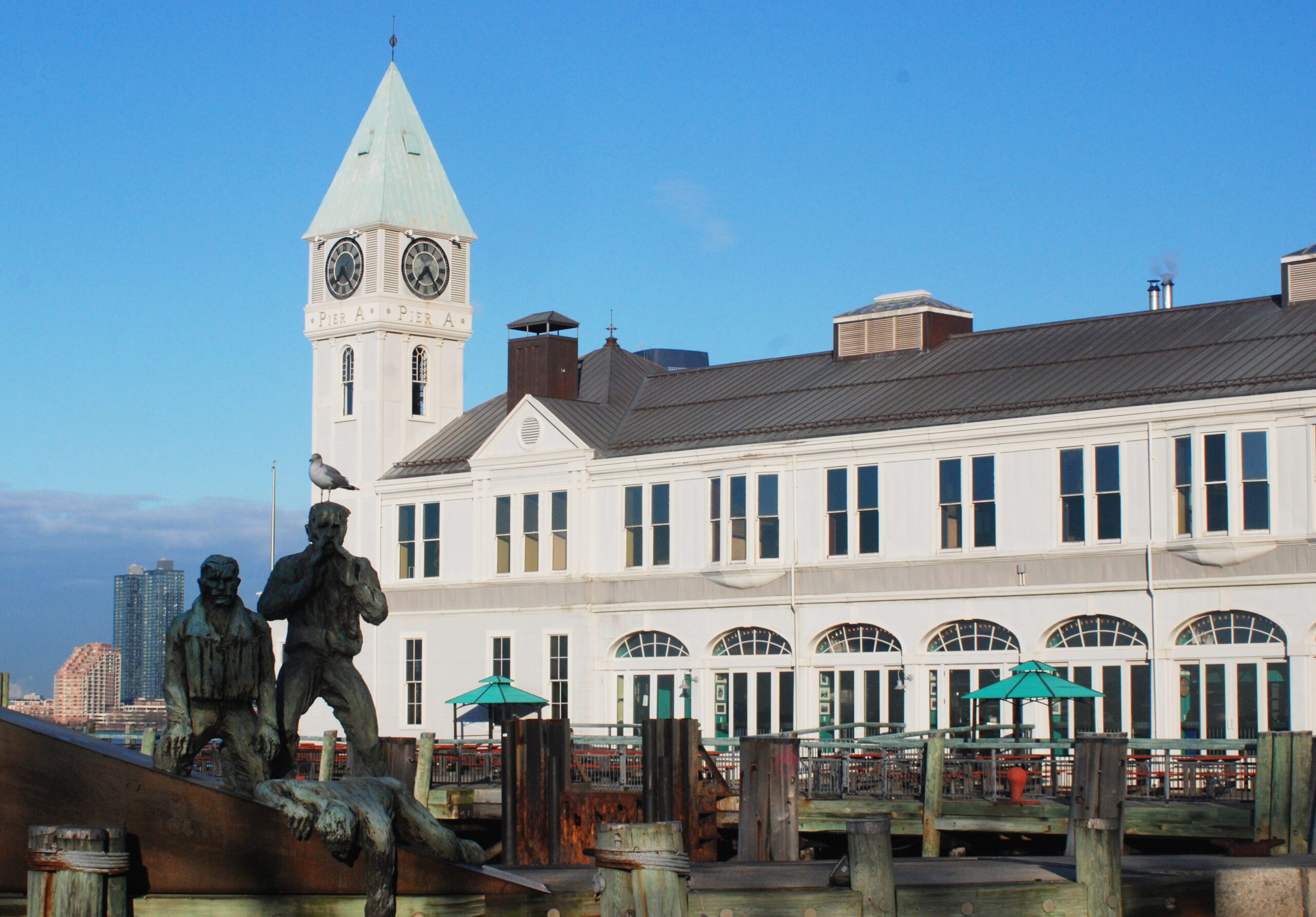
The now-vacant Pier A, owned by New York City, was home to the “megalithic” Harbor House dining venue for a half-dozen years before it ceased operations during the coronavirus pandemic. In civil lawsuits, workers there claimed wage violations amounting to hundreds of thousands of dollars. // Photo by Scott Brinton/Long Island Advocate
Since the early to mid-2000s, restaurant developer Peter Poulakakos has steadily built a portfolio of fashionable eateries across Lower Manhattan. The collapse of one of his more recent projects — Pier A Harbor House at the southern tip of Manhattan — leaves the future of a New York City historic landmark in question.
By Scott Brinton
Part two of two. For the first installment of this story, click here.
Pier A Harbor House, a three-story, 28,000-square-foot collection of high- and medium-end dining venues overlooking New York Harbor, lies vacant these days, its many stools resting upside down atop bars and tables, its wine glasses collecting dust and its stainless-steel beer kegs stacked on shelves.
A handful of notes taped to the inside of its glass doors read, “Pier A will be closed until further notice. We apologize for the inconvenience. Be safe.”
Restaurant developer Peter Poulakakos, whose portfolio of roughly 20 Manhattan eateries has been described as an “empire,” was the force behind Harbor House, along with his father, Harry, who founded the iconic Harry’s at Hanover Square, only blocks from Wall Street, in 1972.
In 2011, the Poulakakoses joined with the Dermot Company and others to develop the Harbor House. That March, Pier A Battery Park Associates LLC, of which the Poulakakoses are listed as owners in court documents, signed a 25-year lease to Pier A with the Battery Park City Authority, a New York State public benefit corporation. The BPCA is responsible for the site and is charged with management of several other venues within the 92-acre Battery Park City neighborhood on Manhattan’s southwest side.
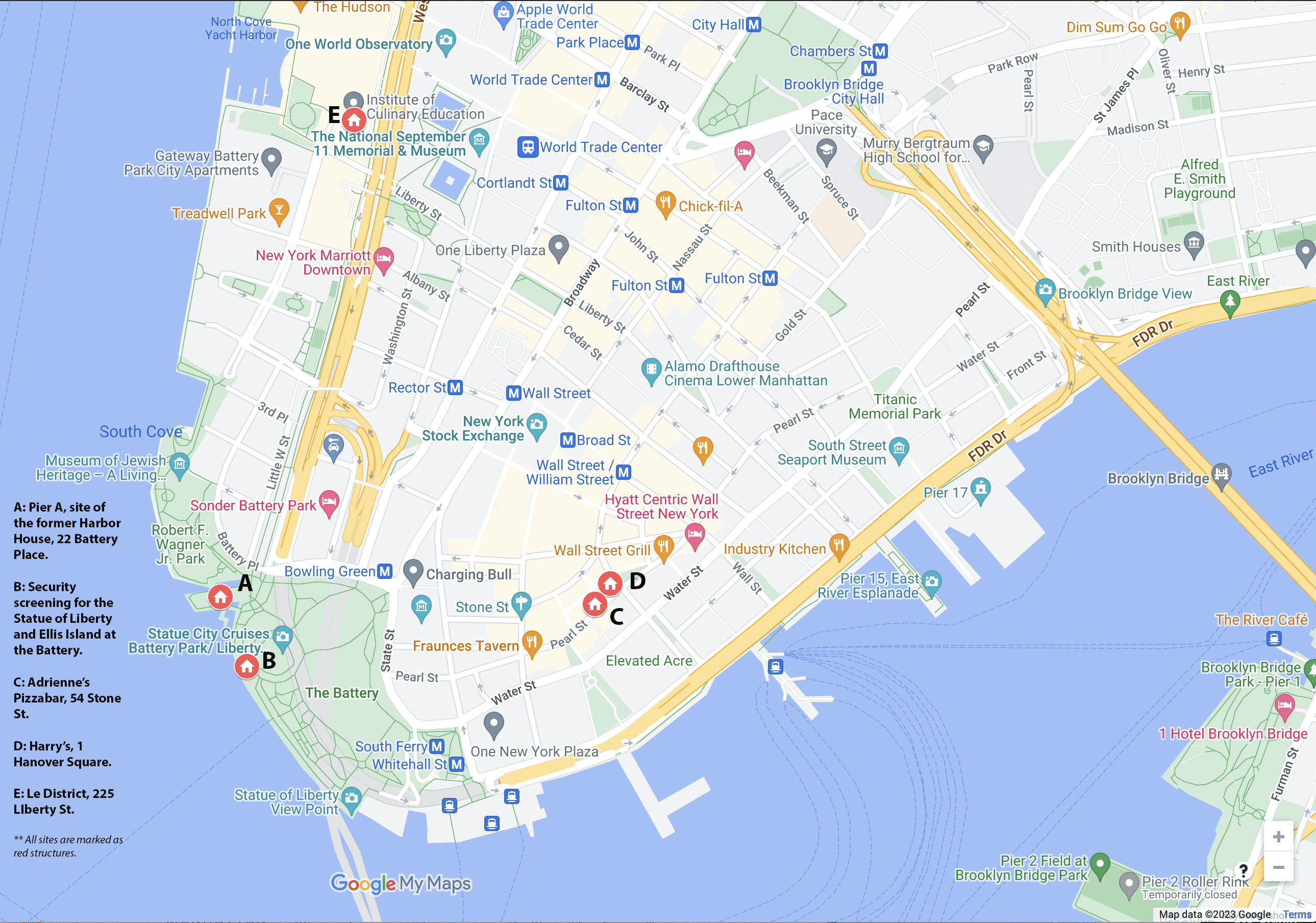
Google Map by Scott Brinton/Long Island Advocate
The lease was worth $39.1 million in rent over its life, in addition to a percentage of annual gross sales above $18 million. Though New York City owns the pier, the BPCA acts as the landlord, as it leases the site from the city, so the agreement that it signed with Pier A Battery Park Associates was a sublease.
Now, it is unclear how the BPCA will recoup the millions of dollars in lost rent that it was to receive from Pier A Harbor House.
The BPCA referred The Advocate to a public affairs consultancy firm, Risa Heller Communications of Manhattan, which had no comment.
Here’s my latest on the Hofstra University Herbert School of Communication’s Long Island Advocate:
Workers gathered outside Nick’s Pizza in Rockville Centre Wednesday “to demand” that Nicholas J. Angelis pay the hundreds of thousands of dollars in back wages that, according to court documents, he owes eight former kitchen workers. Angelis is also named in four class-action civil lawsuits against a popular pizzeria in Manhattan’s Financial District, all alleging wage violations. One of Angelis’s partners in the eatery, Peter Poulakakos, is named in 12 suits. // Photo by Scott Brinton/Long Island Advocate
By Scott Brinton
Part one of two.
Diana Sanchez, regional organizer for the National Day Laborer Organizing Network, stood feet from the glass-door entrance to Nick’s Pizza, on Sunrise Highway in Rockville Centre, and shouted into a microphone, “Shame on you!”
The dozen protesters assembled in a tight semi-circle around her responded in kind four times.
The demonstrators were there Feb. 8 “to demand” one-time owner Nicholas J. Angelis, of Rockville Centre, pay eight of his former workers the hundreds of thousands of dollars in back wages that the New York State Department of Labor contends they are owed.
They are “workers who have families, who have children, who have to survive,” Sanchez said.
Roughly a decade ago, Angelis, now 62, was ordered by the DOL to pay a combined $421,0000 in back wages, interest charges and liquidated damages to eight of his kitchen workers at Nick’s Pizza, in addition to $311,500 in state penalties, for a total of more than $730,000. In a two-year probe that began in 2009, the DOL found that Angelis had paid the workers a rate below minimum wage from 2003 through July 2011, court documents show.
They are “workers who have families, who have children, who have to survive.”Diana Sanchez, National Day Laborer Organizing Network
The workers are yet to receive any of the funds that they are owed, despite two New York State Supreme Court judgments in their favor in July 2021 and May 2022 — hence the protest in front of Nick’s on Wednesday. All eight came to the U.S. as undocumented workers, from El Salvador, Honduras and Mexico, though one is now a permanent resident.
Nick’s Pizza, at 272 Sunrise Highway in Rockville Centre, last September. // Long Island Advocate file photo by Scott Brinton
The Advocate first reported on the state orders and court judgments against Angelis last September. In further investigating the case in recent months, The Advocate uncovered four class-action civil lawsuits alleging wage violations against Pizza on Stone LLC, which does business as Adrienne’s Pizzabar, in between Pearl Street and the cobblestone-covered Stone Street, only blocks from Wall Street.
Angelis, who plays a key leadership role in Adrienne’s Pizzabar, according to its website, is named in the suits, along with Peter Poulakakos, one of the eatery’s owners and a restaurant developer who has steadily built an “empire” of roughly 20 high-end dining establishments across Lower Manhattan over the past two decades.
The wage-violation cases against Adrienne’s Pizzabar are four of a dozen such class-action civil suits filed against LLCs/restaurants owned by Poulakakos and others dating back to 2011. The suits were found on PACER, the online database of federal electronic court records, in a joint, four-month investigation by The Long Island Advocate and WABC “Eyewitness News.”
To date, 10 of the suits have been settled, with ventures owned by Poulakakos and his partners agreeing to pay more than $1.9 million combined to dozens of employees and their lawyers, though Poulakakos and others admitted no wrongdoing and their attorneys “sharply” and “vigorously” contested the allegations against their clients’ businesses in court filings.
Outside of the Adrienne’s Pizzabar cases, Angelis was not named in the other suits.
“Out of Sight,” by Seward Johnson, 1991. The piece is one of 35 now on exhibit at Old Westbury Gardens. // Photo by Scott Brinton/Long Island Advocate
By Scott Brinton
Perhaps it was the slant of the sun on this July 4 afternoon, or maybe it was the statue’s shimmering metallic sheen, or both, but one piece in the Seward Johnson exhibit now on display at Old Westbury Gardens — of a guitarist strumming away by a lake in the forest, titled “My Dog Has Fleas” — took on an ethereal quality, as if it were an apparition.
“My Dog Has Fleas,” by Seward Johnson, on display in the woods at Old Westbury Gardens. // Photo by Scott Brinton/Long Island Advocate
One could be forgiven for imagining you were seeing ghosts in this outdoor sculpture show. Johnson’s bronze statues of seemingly ordinary people engaging in everyday activities, such as reading a chemistry textbook or flying a kite, are so full of life-like detail that they at once appear alive, yet frozen in place, as if cryogenically preserved.
Johnson’s attention to detail is impeccable, as shown here in these ripped jeans on the sculpture “My Dog Has Fleas.” // Photo by Scott Brinton/Long Island Advocate
Angelina Escobar, 11, and Kelli Crespin, 12, members of the Boys-Under 12 Halcones, or Hawks, ran through their paces during a recent Thursday afternoon practice. The Halcones, one of nine New York Soccer Latin Academy teams, had finished its season in the Long Island Junior Soccer League the day before. // Photo by Scott Brinton/Long Island Advocate.
I had such great fun covering this story for Hofstra University’s Long Island Advocate:
By Scott Brinton
The soccer players, all 10- and 11-year-old members of the Panteras, or Panthers, started to assemble in a semi-straight line in front of the net before 5 p.m. for their 5:30 practice on a recent Thursday, firing furious shots on goal, conversing at breakneck pace in Spanish and occasionally screaming in delight when a ball, booted from afar, landed squarely at the back of the net.
It was a seemingly chaotic, yet perfectly organized scene on a back field at NuHealth’s A. Holly Patterson Extended Care Facility in Uniondale on this partly cloudy, 75-degree day.
All the while, parents and guardians pulled up in mini-vans and SUVs to drop off their kids. Some parked and sat cross-legged on the sidewalk at the edge of the unlined field full of clover, watching intently from beneath the shade of soaring oaks while chatting in Spanish on their cell phones.
Within an hour, all four soccer fields there were full of children, many first-generation immigrants from Latin America, laughing and huffing their way through their practices, all led by volunteer coaches.
This is where, week after week, the New York Soccer Latin Academy prepares for competition in the Long Island Junior Soccer League and any number of summer tournaments. The academy was founded in 2002 to give Hispanic boys and girls, ages 5 to 19, a safe place to learn the fundamentals of the game that, for decades, has captivated the peoples of Mexico and countries throughout Central and South America.
South of the U.S.-Mexican border, soccer, or fútbol, is more than a game; it is deeply ingrained in the culture of Latin America, said Francisco Guerrero, a NSYLA coach who founded the club and owner of the Sanzivar Auto Repair and Body Shop in Hempstead.
Francisco Guerrero, who founded the New York Soccer Latin Academy in 2002, at his Hempstead auto repair and body shop, Sanzivar, with NYSLA and other team photos covering the walls. // Photo by Scott Brinton/Long Island Advocate
“We want to give our kids the best we can give them,” Guerrero, 54, said during an interview at his dimly lit office, whose walls are covered by NYSLA team photos. “Everybody who wants to learn, we’re going to give our time to teach them soccer.”
Registration is $400 for the year, divided in two payments, to cover the cost of LIJSL registration and uniforms. For players in need, their families pay what they can. No child is cut. In these respects, NYSLA is very different than many Long Island youth soccer clubs, where travel fees and expenses can run into the thousands per year, many trainers are paid, and players, particularly in the older divisions, can be cut.
With all that is happening in the United States and around the world at this moment, it is too easy to forget the war that Russia is waging at this very moment on the democratic nation of Ukraine. Below are links to some of my coverage of the war from the Long Island perspective. I post this to remind myself that the story continues, and I must continue this work. — Scott A. Brinton