‘Eyewitness News’ sets up shop at Hofstra’s Herbert School

WABC-TV’s “Eyewitness News” opened its Long Island Bureau at Hofstra University’s Lawrence Herbert School of Communication on May 4 in a partnership that is expected to benefit both WABC reporters and LHSC students. // Photo by Scott Brinton/Long Island Advocate

Great fun serving as the photographer for this piece by….

By Megan Naftali

On the count of three at 1:47 p.m. May 4, two Hofstra University students pulled down a dark cloth covering the brick wall outside the WRHU Radio station at the Lawrence Herbert School of Communication, revealing a sign to mark the new partnership between LHSC and WABC-TV’s “Eyewitness News.” 

The multi-award-winning newscast’s Long Island Bureau is now located at WRHU.

“For more than 50 years, ‘Eyewitness News’ has been the leader in live breaking news and weather coverage,” Chad Matthews, president of ABC-owned television stations, told the crowd gathered in LHSC’s Studio A for the 1 p.m. ceremony to open the new bureau. “When Al Primo launched the ‘Eyewitness News’ format, it was revolutionary, bringing the news to the viewers live from where it happened. This partnership allows us to evolve that right here on Long Island.” 
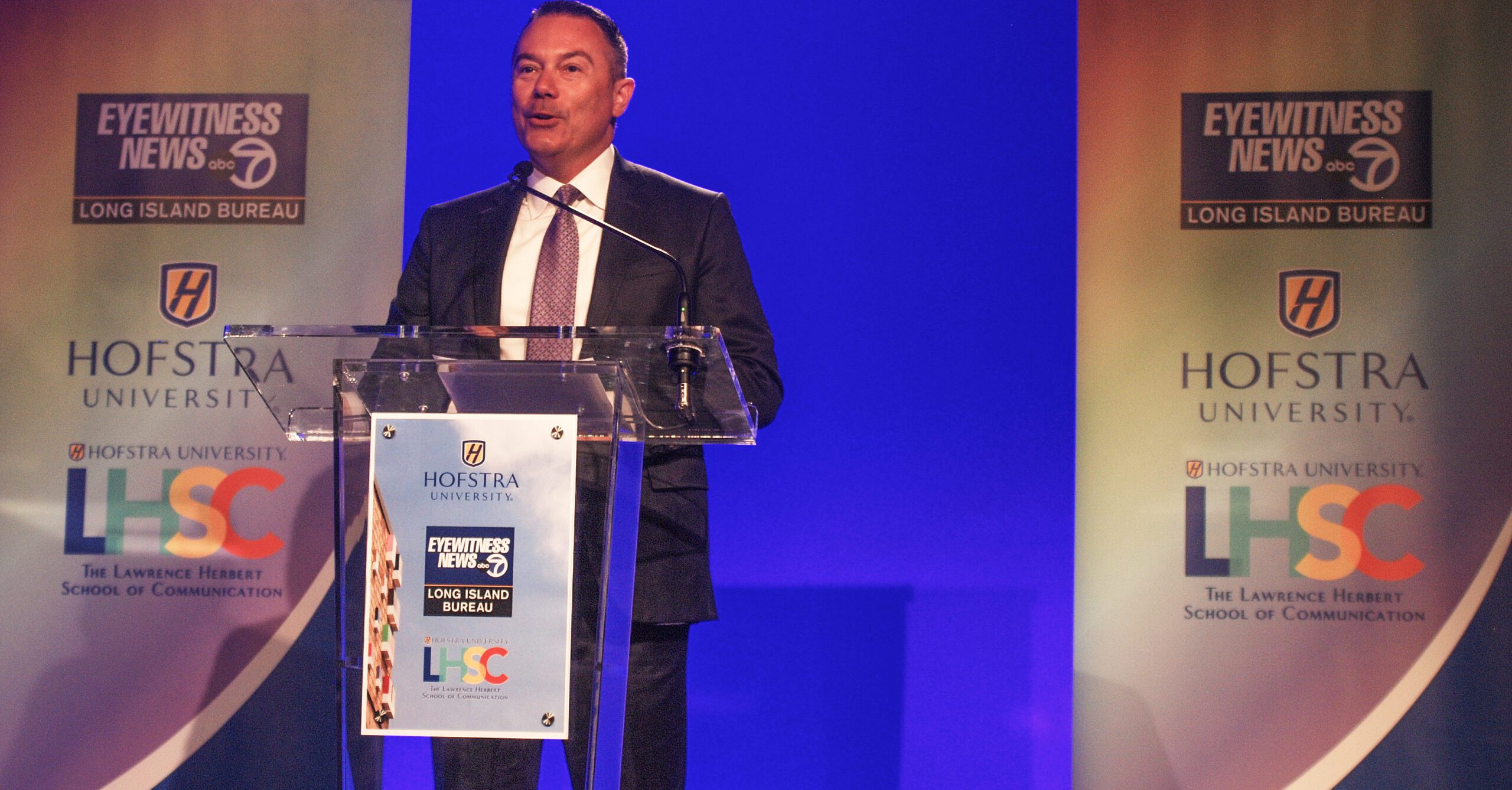
Chad Matthews, president of ABC-owned television stations, was among the featured speakers Wednesday to announce the partnership between the Lawrence Herbert School and WABC’s “Eyewitness News.” // Photo by Scott Brinton/Long Island Advocate

“Nassau and Suffolk counties are a huge part of our market,” Matthews continued, “and having a robust operation here in the heart of the Island is vital to our mission to inform and serve our community.”

“Eyewitness News” anchor Bill Ritter served as the ceremony’s emcee and said he believes the partnership will benefit not only students, but also WABC journalists and the Long Island community.

“We get a different sense of the community through the eyes of the students because they look at it very differently than us old folks who may pay property taxes, go to work and have to be responsible for other people,” Ritter said. “The freedom that they have when they’re in college I think will help keep our reporters plugged into what may be happening in the communities out here.”

“Eyewitness News” anchor Bill Ritter offered his often humorous take on the news while serving as emcee for the ceremony to announce the Hofstra-WABC partnership. // Photos by Scott Brinton/Long Island Advocate
Mark Lukasiewicz, the Lawrence Herbert School dean and a former ABC News executive and senior producer, was instrumental in securing the new partnership with WABC, Hofstra officials said. 

To continue reading, click here.

Governor Hochul talks $1B pothole plan in Hempstead

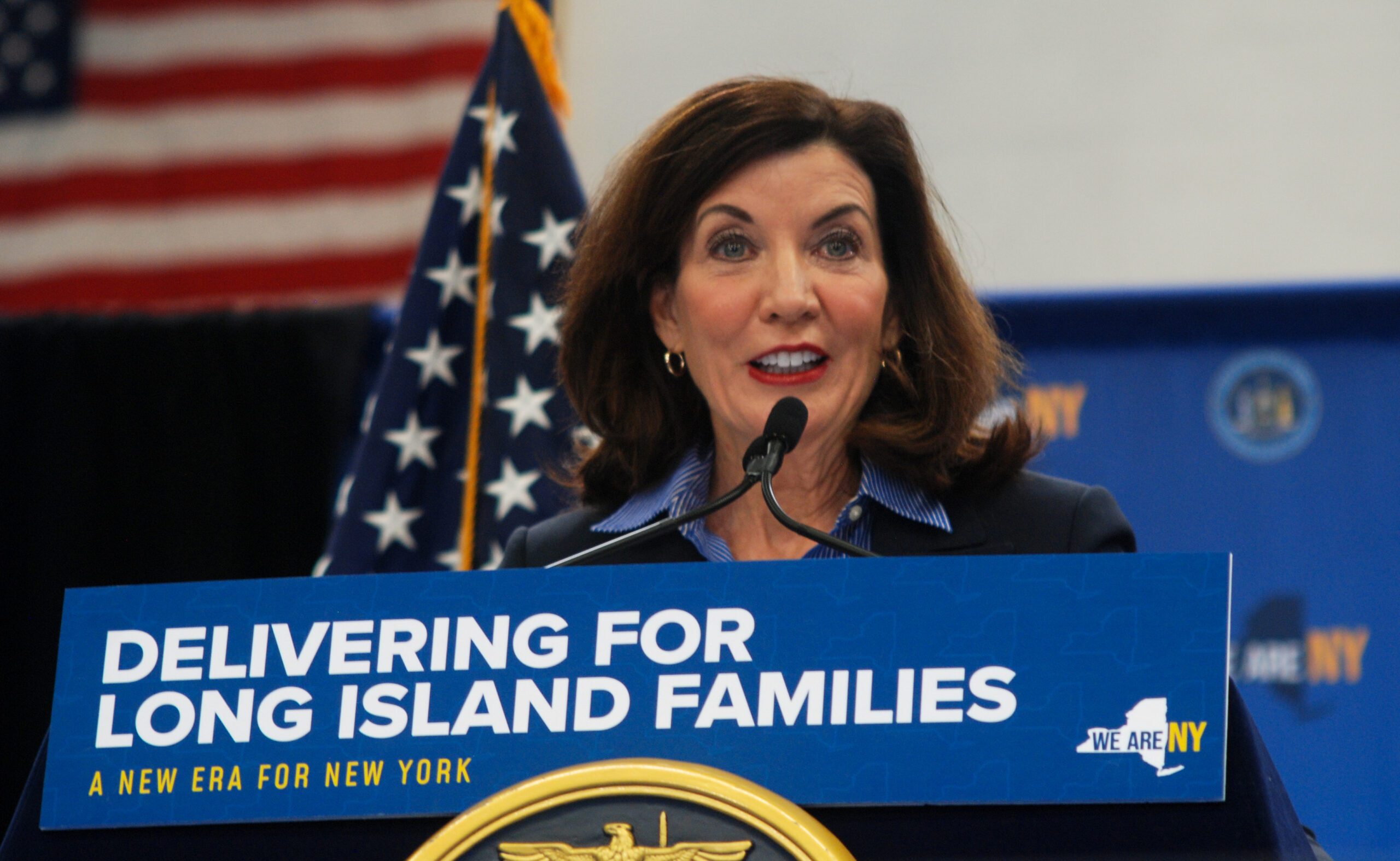
Gov. Kathy Hochul spoke Tuesday about the many initiatives New York State is taking on with a larger-than-usual budget that was made possible, in part, by federal coronavirus relief funding. // Photo by Scott Brinton/Long Island Advocate

I was happy to serve as the photographer for this Long Island Advocate story….

By Damali Ramirez and Hunter Spears

Gov. Kathy Hochul landed at Kennedy Memorial Park in Hempstead April 19 to promote a $1 billion plan to repair New York’s broken roads as part of what she is calling “Operation Pave Our Potholes,” along with a host of other initiatives passed recently in the state’s $221 billion budget for 2023. 

In her speech, Hochul, who faces a Democratic primary June 28, highlighted how the spending plan would improve infrastructure and education in Nassau and Suffolk counties, saying the budget was larger than usual because it was bolstered by one-time federal coronavirus pandemic relief funds. She said the state’s increased spending would help usher in a “new era for New York.”

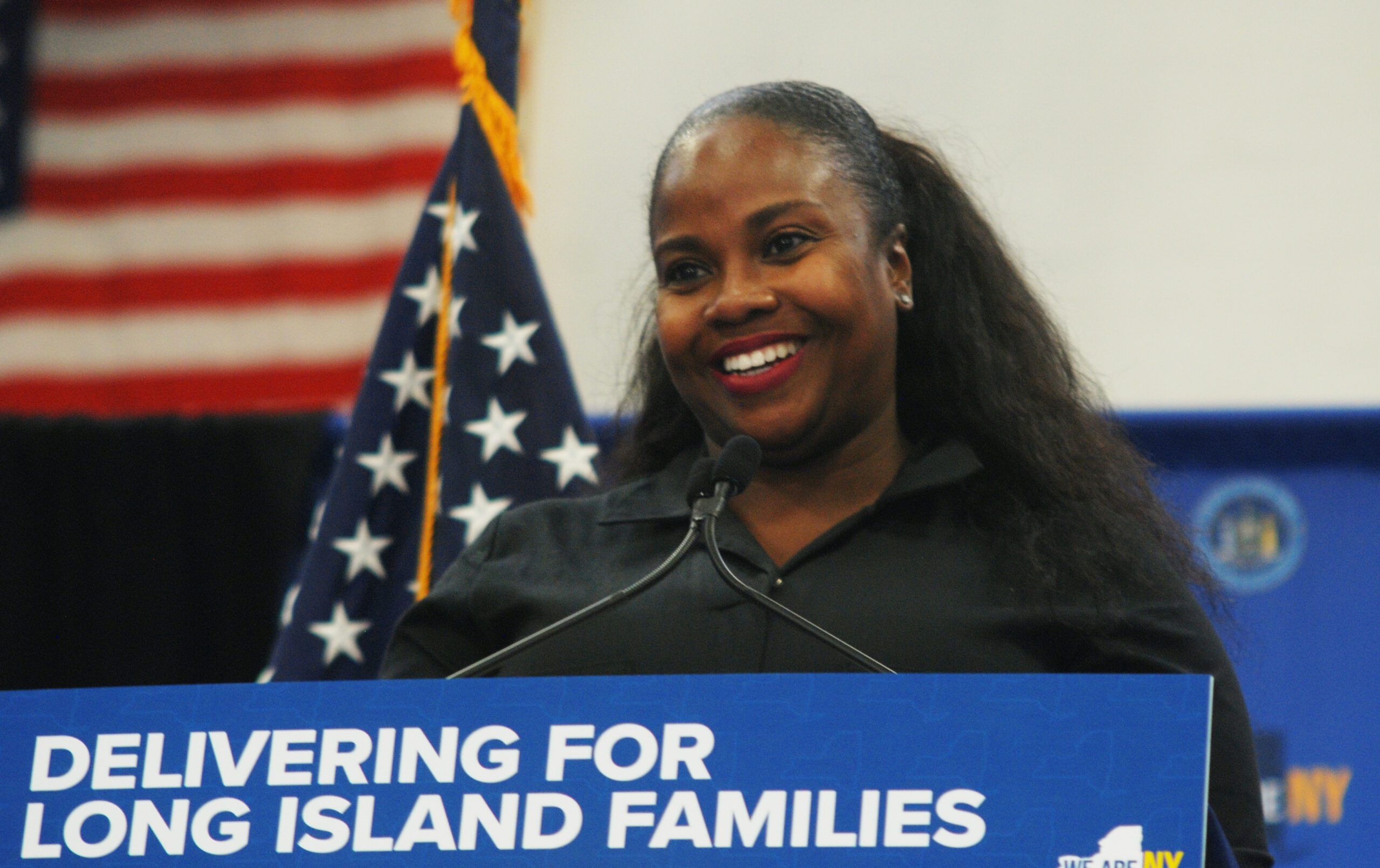
Assemblywoman Taylor Darling, a Democrat who represents the 18th District, which includes Hempstead, has advocated strongly for pothole repair, the governor said. Darling joked that her lobbying has earned her the nickname “Pothole Princess.”

State Assemblywoman Taylor Darling, who was among the speakers Tuesday, said she planned to fill some potholes on the Meadowbrook Parkway with Hochul after the governor’s speech. // Photo by Scott Brinton/Long Island Advocate

To continue reading, click here.

Celebrating Ukrainian cuisine to fundraise for relief

Volunteers from across the Long Island Ukrainian community gathered at St. Vladimir’s Parish Center in Uniondale over the weekend to make varenyky — potato-and-cheese dumplings — as a fundraiser for Ukrainian relief. // Photo by Scott Brinton/Long Island Advocate

By Scott Brinton

Sautéing onion scented the air in the ring-shaped main hall of St. Vladimir’s Parish Center in Uniondale last Sunday as a frenetic swirl of people moved about carrying trays full of varenyky — potato-and-cheese dumplings.

The event, one part of a three-day fundraiser for Ukraine relief, brought together volunteers from across Long Island’s Ukrainian community and beyond. The varenyky (pronounced vah-rEH-nee-key) were sold in small aluminum trays, 12 to a pack, with the goal of raising $10,000, said Halyna Fenchenko, head of the Organization for the Defense of Four Freedoms for Ukraine, 42nd Branch, on Long Island.

“We’re going to send every penny to Ukraine . . . We’re going to give to the hospitals — wounded people,” said Fenchenko, who is originally from Ternopil, a city of 215,000 in Western Ukraine.

Making of the varenyky started on Friday and Saturday with a small group of volunteers who prepared the mashed potato filling that was stuffed on Sunday inside a sturdy dough of water, egg, flour and salt and then shaped into neatly crafted half-moons before cooking. Dozens of volunteers turned out for the final stage of varenyky production March 27.

To continue reading, click here.

‘Biking Borders’ brings out the best of humanity

My latest #LIHerald.com column….

The 2019 documentary “Biking Borders,” chronicling the nine-month, 9,320-mile cycling adventure of two college friends, Max Jabs and Nono Konopka, from Berlin to Beijing, opens with the pair struggling to stay upright as they pedal down a snow-covered road in eastern Turkey shortly after Christmas 2018.

These guys are just nuts, I thought. Immediately, I was hooked. I had to watch this travelogue — twice.

Following its opening scene, the film, recently released on Netflix, cuts to Germany and thereafter follows the pair’s journey chronologically, starting in the summer of 2018 at the Brandenburg Gate and ending at China’s Tiananmen Square in the spring of 2019.
Viewers quickly learn that their trek was far more than a sightseeing tour of Europe, the Middle East and Asia. It was fundraiser to build a school in Guatemala, which has the highest illiteracy rate in Central America — roughly 25 percent. 

We also learn that the two, despite attending university in the biking capital of the world, the Netherlands, had barely pedaled anywhere before their epic trek. Apparently, Jabs had ridden a little while in school, but Konopka not at all. In fact, the two undertook no special athletic training for their journey. According to a Forbes article on them, they figured they would get in shape on the way.

As noted, these guys just seemed nuts — but in the best of ways.

To continue reading, click here.

Nassau should enforce state’s mask mandate

Our latest #LIHerald.com editorial….

Bruce Blakeman’s first public act as Nassau County executive-elect, in the second week of December, was one of rebellion. Gov. Kathy Hochul, a Democrat, had ordered mask use in indoor spaces where people gather to reduce the spread of the coronavirus. Blakeman, a Republican, said he would defy the order, refusing to enforce it once he took office Jan. 1. The governor had left enforcement to the counties.

We understand Blakeman’s reluctance to reinstate a mask mandate. People have grown tired of obeying orders. Most of us just want our freedom back. We want our old pre-pandemic lives. We crave normalcy.

Apologies for the blunt language, but the coronavirus doesn’t give a damn about our desire to return to the way things were before all hell broke loose. It is a virus. It has an innate need to replicate, and to replicate it requires host bodies. Nature has granted the virus a seemingly incalculable ability to mutate to avoid eradication. 


That is why we must do all in our power to eliminate the coronavirus — including wearing masks in public spaces. That is why the state mandate is necessary.

Blakeman has said there is little scientific evidence to demonstrate that masking reduces transmission of the coronavirus. That is not true. He only need look to the federal Centers for Disease Control and Prevention’s Science Brief from Dec. 6, titled “Community Use of Masks to Control the Spread of SARS-CoV-2,” to find it. 

To continue reading, click here.

Recalling two failed coups that will live in infamy

By Scott A. Brinton

“The Event,” a 2015 found-footage documentary by Ukrainian director Sergei Loznitsa, opens with black-and-white images of mostly men marching in August 1991 through the streets of Leningrad, in the then Soviet Union, overturning a trailer and grabbing all manner of furniture to erect hastily constructed barricades. Worry was etched on the protesters’ faces.

People had assembled in Leningrad’s central Palace Square and surrounding streets to stop an attempted coup d’état that, they believed, was radiating from Moscow, the USSR’s capital, across the land. 

“The Event” is a hopeful but strangely haunting film that I watched recently on Zoom. Hofstra University’s Department of Comparative Literature, Languages and Linguistics and the History Department presented it, with a panel discussion moderated by Dr. Ben Rifkin, a Hofstra professor of Russian.

I wanted to see the film because in August 1991 I was a Peace Corps volunteer stationed in Bulgaria, a Soviet satellite nation for 45 years, from the end of World War II through 1990, when it finally gained its freedom and turned to democracy. I cannot express the chilling effect the coup attempt had on many Bulgarians, who worried about a sudden return to hardline communism. I wondered what, precisely, had happened in Moscow and other Soviet cities from Aug. 18 to 21, 1991, as the coup unfolded. I had never seen images of it before.

The good people of Leningrad were concerned that Soviet Armed Forces tanks might roll against their city, and a sea of tens of thousands of people rallied, placing themselves in mortal danger to preserve the democratic reforms enacted under Soviet President Mikhail Gorbachev.

To continue reading, click here.

Think green — clean your vehicle at a car wash

My latest #LIHerald.com editorial…

Bravo to New York state voters for overwhelmingly passing a ballot referendum last week adding wording to the New York Constitution’s Bill of Rights guaranteeing the right to clean water, air and a healthful environment.

The measure passed with nearly 70 percent of the vote. Some 1.9 million New Yorkers voted for it, while roughly 860,000 voted against it.

Clearly, New Yorkers were signaling that, yes, they care about the environment, and yes, they would like to protect it.

Here’s the challenge: It’s one thing to put to paper that you care about the environment. It’s another thing entirely to act, day in and day out, in a manner that actually protects the environment. Each of our daily actions — many of them seemingly small — can either contribute to protecting our environment or potentially do irrevocable harm.

Take washing your car, for example. How you wash it can have a profound effect on the environment, particularly the wetlands that hug Long Island’s shores.

To continue reading, click here.

A famed journalist enlightens us on cancer reporting

By Scott A. Brinton

My latest #LIHerald.com column….

It’s rare that you get the chance to meet your professional heroes, so when one of mine, former Newsday environmental reporter Dan Fagin, now the director of NYU’s graduate Science, Health and Environmental Reporting Program, recently came to Hofstra University to give an hour-long talk on his seminal book, the Pulitzer Prize-winning “Toms River: A Story of Science and Salvation,” I had to attend. 

His 462-page masterwork, published by Bantam, recounts the decades-long history of industrial-waste mismanagement and malfeasance in Toms River, N.J., a seaside community of about 94,000 an hour and a half south of New York City. I read the book shortly after it was published in 2014, and ever since, I had hoped to meet Fagin, now 58, of Sea Cliff.

Toms River is known for its high rate of childhood cancers, in particular leukemia among girls under 5, from the early 1970s through the 2000s. Government reports attribute the spike, at least in part, to the “public health hazards” posed by widespread soil and water contamination at a now-closed Ciba-Geigy chemical plant and a massive, illegal toxic-waste dump at Reich Farm, which has been cleaned up, but only came under consideration for removal from the federal Superfund Site list this year. Both the plant and the dump tainted local drinking-water wells, according to the New Jersey Department of Health. 

In “Toms River,” Fagin details the sordid events that spread a witch’s brew of carcinogens among the good people of this otherwise safe community, which has a reputation for patriotism, a vibrant civic culture and a deep love of Little League baseball.

Toms River reminds me of so many Long Island coastal communities — earnest, hard-working, conservative-leaning but not extreme in its political views, inhabited by professionals and blue-collar workers alike. And, as is the case in more than one Long Island community, innocent residents there were forced to cope with an industrial disaster not of their making.

To continue reading, click here.

Recalling Long Island’s indigenous peoples

My latest #LIHerald.com editorial….

Columbus Day has been celebrated in the United States since 1971, when President Lyndon B. Johnson signed legislation proclaiming it a federal holiday. For years, the holiday has been controversial. 

It is a source of pride for many Italian-Americans who commemorate the global reach of Italy’s most celebrated explorer. At the same time, for many others, particularly Native Americans, Columbus’s arrival in the New World in 1492 represents the beginning of centuries of enslavement and war.

On Oct. 8, President Biden became the first U.S. president to also proclaim Columbus Day, on Oct. 11 this year, Indigenous Peoples’ Day, which began in 1992 as a celebration of native cultures — and a counter-narrative to Columbus’s legendary exploits.

To continue reading, click here.

Elegy for Sears — and, perhaps, mall culture

By Scott A. Brinton

My latest #LIHerald.com column…

Long Island recently lost its last Sears, that once ubiquitous powerhouse retailer that sold a range of goods, from sturdy jeans to solidly built power tools and refrigerators. Started in 1893 as a mail-order catalog to peddle watches to farmers, Sears built a favorable reputation through much of the 20th century as a mainstay of America’s burgeoning middle class. 

By the time I was born in 1967, Sears was the world’s largest retailer, serving as an anchor tenant at malls across the land. Construction on Sears Tower in Chicago — which became the world’s tallest skyscraper, at 1,450 feet — began in 1969 and was completed four years later. Called Willis Tower these days, it’s now the world’s 12th tallest building.

Sears once boasted locations throughout Long Island, including in Valley Stream, New Hyde Park, Garden City and Hicksville. The final holdout was at the Sunrise Mall in Massapequa, where about a third of the storefronts are vacant, Newsday recently reported.

My childhood is inextricably linked to Sears. Every year in August, my parents, both teachers, brought my brother and me to Sears at the Smith Haven Mall in Lake Grove, in Suffolk County, to buy school clothes. I knew then that summer’s carefree days were fading, and classes would soon begin.

To continue reading, click here.

Are interscholastic sports really worth the cost?

By Scott A. Brinton

I was mowing my backyard lawn in Merrick last Saturday when I was suddenly struck by the strange sensation that I had missed the bus to my race — that I should, at the moment, have been running a 5K or a 10K at a frantic pace instead of plodding along, mower in hand.

The temperature was a perfect 72 degrees, with no wind. Sunshine streamed down. The leaves on the trees were half-brown and turning crisp. Fall was clearly in the air.
Year after year, from my early adolescence to my young adulthood, I ran cross-country every fall, from middle school through college, missing only two seasons in high school. I was conditioned to gear up for the racing season as September neared an end. When the fall air and the angle of the sun in the sky turned just so, I had to be ready to run — hard. 

The nervous anticipation I felt as the racing season approached was embedded in my brain, and every now and again it pops up, even now, more than three decades later. Such was the case on Saturday.

That got me thinking about how screwy the past 18 months must have been for our young athletes, how all of the coronavirus delays and cancellations in their sports seasons must have messed with their heads, whether they were elementary-age kids a few years into athletics or college competitors. When you’ve participated for years in a sport, there is an intuitive sense you feel for its up-and-down rhythms and well-timed rituals.

To continue reading, click here.

Memories of covering 9/11 haunt me still

By Scott Brinton

My wife called soon after 9 a.m. on Sept. 11, 2001, her voice measured but tense. I was half-awake, preparing myself for the day, while our then 1½-year-old daughter slept in the next room of our Long Beach apartment. 

“Turn on the TV,” Katerina said. 

There were the twin towers ablaze in fireballs, black smoke pouring from the structures. Like so many of us, I could only stare, mouth agape, in stunned disbelief. 
My wife was at Lawrence Middle School, where she teaches to this day. The teachers didn’t have a TV to know precisely what was happening, so she called me to find out. She was sitting with a colleague whose husband worked at the World Trade Center. I stuttered as I relayed what I was seeing. 
I can’t recall which station I was watching, but I remember the frantic, frightened voice of a telecaster in a helicopter that whirred from a distance above the twin towers. 

Then, suddenly, the unexpected happened at 9:59 a.m.: The south tower collapsed. The image of its shiny metal exterior cascading down, and then a massive gray ash plume spiraling back up hundreds of feet into the air, was seared into my mind. It haunts my thoughts to this day.

To continue reading this column, click here.

Reflecting on the Sept. 11 attacks 20 years later

Here is my #LIHerald.com editorial to mark the 20th anniversary of the Sept. 11, 2001, attacks on the World Trade Center:

The Sept. 11 attacks on the World Trade Center and the Pentagon and in Shanksville, Pa., set off a cascade of worldwide catastrophes over the subsequent two decades — the wars in Afghanistan and Iraq and many other terrorist attacks, in multiple countries. September 2001 seems like a lifetime ago, but for those old enough to remember that terrible year, it remains a haunting memory, a fever dream that we try to lock in the backs of our brains but is ever-present.
For those of us in Nassau County that day, we could only watch in horror as gray-black smoke plumes spiraled out of the twisted, shattered remains of the twin towers upward into an otherwise perfect azure sky. The plumes were visible from points across the county.
Shortly after the attacks, people started to gather on the beach in Lido and at the Norman J. Levy Park and Preserve in Merrick — the highest point on the South Shore — to watch the billowing smoke, staring silently in stunned disbelief.
The United States homeland was under attack for the first time since World War II, and at that moment, we had no idea who the invader was, or the future suffering in distant lands that the attacks would bring. It was all incomprehensibly terrifying.

To continue reading, click here.

The two most adventurous years of my life

By Scott Brinton

My latest #LIHerald.com column looks back fondly at my two years of Peace Corps service…

Thirty years ago this week, I hopped on an electric train with a bright-red engine, a nervous energy pulsing through my arms and legs straight to my fingers and toes, which fidgeted uncontrollably. My head was spinning. 


I carried all I had in my arms — two gray suitcases of clothes, one violin in a worn brown case and one blue duffle bag with running shoes and toiletries. I was 24 and headed to the greatest adventure of my life, a two-year bicultural exchange that excited me, at times vexed me and forever changed me. 


I served in the U.S. Peace Corps in Veliko Tarnovo, a 5,000-year-old city in central Bulgaria with a medieval fortress that was flanked by white stucco houses, squeezed onto the steep hills above the winding Yantra River. 


In the first week of September 1991, I left the safe haven of the training site the Peace Corps set up in Bankya, a spa resort 11 miles outside Sofia, Bulgaria’s capital, and headed to Tarnovo, as it’s commonly known. After two and a half months of preparations, I still had no idea what to expect. I loved every minute of the next two years.


I was part of the first group of 26 Peace Corps volunteers to enter Bulgaria after the fall of communism there a year earlier. As was the case in Poland, Hungary, East Germany, Czechoslovakia and Romania between 1989 and 1990, thousands of Bulgarians took to the streets to protest communist rule. Todor Zhivkov — the longest-serving Soviet Bloc dictator in the post-World War II era, who reigned from 1954 to 1989 — was deposed without bloodshed. In July 1990, then President Petar Mladenov, a former communist leader, quit over accusations that he had ordered tanks to roll against protesters in December 1989

People rejoiced after Mladenov’s resignation, The New York Times reported on July 7, 1990. “Never again a communist president in Bulgaria!” 5,000 protesters chanted in unison in central Sofia.


To be there, in this place burning with democratic idealism after more than four decades of repressed speech and thought, was the thrill of a lifetime for an American who had freedom of speech and assembly ingrained in him. Bulgaria felt so alive. I felt so alive. People were suddenly free. As an outside observer who was quickly acculturated to Bulgarian beliefs and practices (I married a Bulgarian), I internalized their joy, their relief and, sometimes, their fear of a return to communism.


On June 20 this year, most of the original 26 Peace Corps volunteers, our Bulgarian manager, Emil Patev, and my wife, Katerina, who was one of our language and culture trainers, gathered on Zoom to reminisce. It was perhaps the strangest feeling I’ve ever experienced. Because of the intensity of the experiences that we shared, the names and faces of my fellow volunteers were indelibly etched in my mind. I pictured them as their younger selves, and then we appeared in little boxes on a computer screen, significantly older variations of ourselves, as if this were a “Dr. Who” episode. It was jarring at first.

To continue reading, click here.

Restoring a lost habitat in our backyard

My latest #LIHerald.com column:

In the early morning of April 28, I tiptoed into my dew-coated backyard in Merrick to watch as an orange sun slowly migrated upward, sending its rays streaming through the hundreds of flower-covered branches on the three cherry and two apple trees that my wife and I planted nearly 20 years ago when we first moved in.

It is a glorious moment that I await each year, when I can stand and breathe in the sheer beauty of those life-sustaining flowers, all white and pink. Each is such a tiny, seemingly insignificant thing. Collectively, however, these flowers constitute a powerful force.

This is the natural world reborn in what was once a virtually lifeless suburban backyard. When my wife and I moved in, our yard was all lawn except for a handful of hydrangea, holly and Japanese yew bushes, two scrawny dogwood trees and one ornamental cherry around the edges.

In the early years in our home, we ripped out about half of the lawn to make way for many more trees, bushes and flowers, a number of them native species. We wanted to recreate, in a sense, the backyards that we knew as children. I grew up in rural Yaphank, in Suffolk County, surrounded by a dense forest of white pine and oak trees. My wife was raised in Sofia, Bulgaria’s capital, but spent many days in her family’s village of Rajdavitsa, amid cherry orchards full of wildflowers.

We wanted trees through which squirrels and birds could scurry and construct their nests. We wanted a natural habitat.

Two decades later, I’m proud to say that we have one. The cherries that we planted are more than 20 feet tall, and the apples, over 30 feet. All were purchased as one-foot bare-root saplings for a couple dollars each from the Arbor Day Foundation. We also planted four arborvitae, three maples, two white pines, two dwarf Alberta spruces, a Japanese maple, many more hydrangeas and hollies, boxwoods, barberries, red osier dogwoods, butterfly, raspberry and blackberry bushes, forsythias, fountain and maiden grasses, euonymuses, lilies, lilacs, hostas, black-eyed Susans, peonies and purple cone flowers, among others

Where once there was no wildlife, now we have bees and butterflies and birds — red cardinals, blue jays, European starlings, grackles, house sparrows, Baltimore orioles and my wife’s favorite, mockingbirds. We’ve even had birds build nests in our trees, including a robin and a mourning dove. I love that. There are also squirrels, which eat our apples and, occasionally, our tomatoes, as well as raccoons and opossums here and there.

This year we certified our yard as a Wildlife Habitat with the National Wildlife Federation. We started the simple process by answering a few quick questions: Does your yard provide shelter and food for wildlife? Is there a water source from which wildlife can drink? Are you committed to natural yard maintenance, without the use of synthetic pesticides, herbicides and fertilizers? Then you pay a fee — certification is a fundraiser for this nonprofit environmental organization. Finally, NWF sends you a beautiful green metal sign, which we staked in our front yard’s center bed for all our neighbors to see as they’re out walking their dogs or jogging by.

To continue reading, click here.

U.N.: Climate change is real, and it’s getting uglier

The United Nations’ latest climate crisis report is frightening. You know I had to write a #LIHerald.com editorial:

To the climate deniers, we say this: Wake up.

July was the hottest month in the past 142 years, since humans started recording climate data, according to the National Oceanic and Atmospheric Administration. July had previously been the hottest month ever recorded in 2016, 2019 and 2020.

What we are seeing now is climate change play out in real time, as predicted by scientists dating back to the 1960s and the administration of President Lyndon Johnson. As a nation, we have largely ignored the crisis, pretending it wasn’t happening, hoping the scientists had got this one wrong. They didn’t. We can see that now.

We can see it in the massive wildfires that have consumed swaths of the American West and southern Europe. California and Colorado may be on fire, but so are Italy and Greece.

No fewer than nine wildfires are now ravaging California. Exacerbated by extreme drought, the Dixie Fire has burned since July 13 and scorched more than half a million acres in Plumas and Butte counties. Need we say more?

The climate crisis is particularly worrisome for Long Islanders. We, after all, live on an island surrounded by the Atlantic Ocean and the Long Island Sound, which are predicted to rise because ice shelves in Greenland and Antarctica are melting into the seas, causing water levels to rise, inch by inch, foot by foot, over decades.

The 195-member United Nations International Panel on Climate Change recently released its sixth Assessment Report, offering the consensus findings and opinions of thousands of the world’s leading climatologists. The warnings are dire.

When the IPCC began its work 33 years ago, it built some small level of doubt into its reports that maybe, just maybe, humans weren’t the cause of the Earth’s rapidly rising temperatures. Not anymore. In its most recent report, issued only weeks ago, the IPCC stated, “It is unequivocal that human influence has warmed the atmosphere, ocean and land.” As a result, the report continues, “Widespread and rapid changes in the atmosphere, ocean, cryosphere and biosphere have occurred.”

To continue reading, click here.

The time is right for offshore wind

My latest liherald.com editorial….

Plans to construct a wind farm in the ocean 15 miles south of Jones Beach will undoubtedly be met with opposition. The Long Island Commercial Fishing Association has already weighed in against the project, saying it could disturb vital fishing grounds. There will likely be others to follow during a two-year environmental review.

We mustn’t allow not-in-my-backyard protestations to scuttle such a project again, though. In 2007, plans for a 40-turbine wind farm off Jones Beach, 10 years in the making, were killed largely because of NIMBYist opposition by a small but vocal group called Save Jones Beach. Long Island Power Authority officials claimed the project would cost too much, but studies showed it would have raised ratepayers’ monthly bills by a mere $2.50.

Polling at the time showed Long Islanders overwhelmingly supported the wind farm, despite the rate increase. That’s because most folks understood then, and understand now, that we desperately need renewable energy sources like wind, solar and geothermal to reduce our reliance on dirty fossil fuels such as coal, oil and even natural gas in order to stave off the worst effects of the climate crisis.

Yes, the Earth is heating up beyond the bounds of predictable climactic cycles, and we’re responsible for throwing the world’s mean temperature range out of whack. Power plants, factories, and cars and trucks send more than 40 billion metric tons of heat-trapping carbon dioxide — the chief of driver of climate change — into the atmosphere every year. Since the Industrial Revolution began in 1750, humans have released 2,000 billion metric tons, according to the National Oceanic and Atmospheric Administration.

That is, we have released enough carbon into the atmosphere to substantially alter its composition and set in a motion the climate crisis that we now face.

The question is, what will we do to stop it? Will we bravely seek new, clean forms of energy, or will we keep our heads buried in the sands of our pristine beaches until they’re all underwater?

To read the full editorial, click here.

A writer enlightens us on anti-racism

By Scott Brinton

Here’s my latest liherald.com column:

Until recently, I had never thought deeply how radical my parents were when I was a child. I’m not sure they realized it at the time.

In 1972, when I was 5, they put me on a big yellow school bus whose primary route wound through Gordon Heights, in Suffolk County, a nearly all-Black neighborhood that was developed by Louis Fife in the 1920s. I was one of a handful of white children on the route. Two years later, my younger brother joined me on the bus. 

Growing up in the tiny country hamlet of Yaphank, a nearly all-white community, I had no notion of the frighteningly seismic socio-political events that were breaking out across the country at the time, including an anti-desegregation movement that swept the nation, roiling cities from Boston to Los Angeles and too many points in between, including the Village of Malverne. 

“This place was a virtual war zone in the late 1960s and early ’70s, where you had people standing in picket lines ready to kill each other over issues of integration,” then Malverne Schools Superintendent James Hunderfund told the Herald in 2019. “There was a sense of separatism, and that was prevalent in other places, but it was rampant here.”

In Boston alone, 40 anti-desegregation riots and protests broke out between 1974, the year I turned 7, and 1988, when I was a junior and senior in college. Much of the sound and fury was stirred by a group called Restore Our Alienated Rights, or ROAR, led by its chair, Louise Day Hicks, who claimed she was defending white neighborhoods by pushing back against court-ordered desegregation school busing plans.

Yet my parents put me on that bus, appearing unworried, as if there were nothing out of the ordinary in this seemingly simple act of parenthood. All these years later, I’m happy and proud they did. It is why, in large part, I grew up to be an antiracist, one who works to eliminate racism in American society through words and actions.

I came to this realization when I recently read Ibram X. Kendi’s immeasurably hopeful book, “How to Be an Antiracist” (One World, 2019). In this compact 238-page text, which is one part instruction manual on how to live a life free of racial prejudice and one part personal remembrance and reflection, Kendi, 38, a journalist and university professor, dissects, point by point, the many and varied forms of bigotry while laying out his vision for a socially just society in which all people, regardless of skin color, can achieve equality and happiness.

For the full column, click here.

State must ensure THC products don’t target kids

My latest #LIHerald.com editorial….

The New York State Department of Health should move immediately to ban cookies laced with the THC chemical delta-8, a natural hemp extract that is now legal under the state’s medical marijuana law. Natural and legal, perhaps, but it gives users a high just like marijuana.

State lawmakers like Sen. Todd Kaminsky, a Democrat from Long Beach, and Long Beach school officials recently brought to light the sale of THC-containing cookies like Trips Ahoy! that are cleverly packaged to look like the familiar Chips Ahoy! cookies sold at your local supermarket. The THC-infused cookies are sold at specialty shops.

Cookies like Trips Ahoy! send a bad message to children, who can easily be fooled into believing the cookies are innocuous. They aren’t. 

This was one of the great fears associated with legalizing marijuana: that children would be targeted by the purveyors of pot. There was good reason to believe that. The tobacco industry had long targeted kids with cartoon characters like Joe Camel, until the Federal Trade Commission charged in 1997 that the character violated federal law. The beer industry went after kids with funny-looking frogs.

To read more, click here.

Audubon Society confronts its racist namesake — sort of

My latest liherald.com column….

By Scott Brinton

Birds have fascinated me since I was a boy growing up in Yaphank, in Suffolk County, in the 1970s. My parents spread birdfeed on our slate-covered cement patio in winter, and we would sit — my mother, father, brother and I — and watch the show from our kitchen as cardinals and house sparrows and blue jays descended en masse, scurrying to snatch the feed out from under one another’s beaks. I kept a journal, counting the different birds that landed.

My wife and I continued the tradition with our two kids at our Merrick home, spending many Sunday morning breakfasts watching from our dining room as birds landed on our wooden deck, scampering for breakfast before it was depleted. At one point, we joined the National Audubon Society, among other environmental groups. Now I’m ashamed to say that I had signed us up for the society, despite believing deeply in its mission to protect and preserve birds.

The Audubon Society has done nothing nefarious. It is a top-rated nonprofit environmental organization with a worldwide reach. The trouble, I recently learned, is this: The organization’s namesake, John James Audubon (1785-1851), was an unabashed racist who owned slaves. On June 13, The Washington Post published an article that blew my mind — “The racist legacy many birds carry” — examining the racism that was pervasive among many 19th-century ornithologists and noting the slave-holding past of Audubon, the most famous of all bird lovers.

To read more, click here.