
So, 2020 happened. Nothing went as planned. As journalists, you might like to reflect on it all. At the Press Club of Long Island, we created a platform — Good Riddance to 2020 — to do just that. Check it out here or below. Hope to see you at our GRT2020 Party!
Seeking comfort in a cult classic this pandemic year
In my latest #LIHerald column, I look back at the wonderful and wondrous TV series “Northern Exposure.”
In the interior of Washington state, in the foothills of the Cascade Mountains, there is a tiny city, population about 900, that I have long wanted to visit — Roslyn.
There are no vacation amenities in this place — it is a seemingly ordinary American city, with a handful of eateries and shops and one hole-in-the-wall radio station along its single weatherworn main street. From 1990 to 1995, however, Roslyn was the stand-in for the fictional Cicely, Alaska, in the CBS cult classic “Northern Exposure,” an Emmy Award-winning series that, to my mind, is the finest comedy-drama ever produced, mixing medicine with literature, history, philosophy, religion, music —oh, so much music — and magic to conjure up an idealized version of small-town America.
Yes, the denizens of this very out-of-the-way place disagree and argue — and argue some more — but despite their differences, whether they be spiritual, political or socio-economic, folks seek to understand one another on a deep, existential level, and in the end, they do.
That’s why, I believe, so many viewers love this show, worship it, really, including my wife and me. We discovered “Northern Exposure” in 1993, when we arrived in the U.S. after I had served for two years in the Peace Corps in Bulgaria, where Katerina was born and raised, and we instantly fell in love with it.
Five years ago, I bought the six-season DVD set of the show for Katerina as an anniversary gift, and we set it aside, thinking we would eventually watch and rewatch the show’s 110 episodes, but we never found the time. Then the coronavirus pandemic struck, and it forced us to slow down. Sequestered at home in the early weeks of the crisis, we started watching the series from its start and found solace in this endearing show, which was best described by one reviewer as “esoteric utopian.”
You can read the whole column here.
Peace Corps: A history of spirited engagement
My latest #LIHerald column looks at the wonderful documentary, “A Towering Task: The Story of the Peace Corps.“
Surrounded by thousands of adoring supporters, many sporting red MAGA caps, President Trump sauntered into a victory rally in Cincinnati on Dec. 1, 2016, three and a half weeks after his election, and laid out the Trump Doctrine.
“You hear a lot of talk about how we’re becoming a globalized world,” he bellowed to the chanting and screaming crowd, “but the relationships people value in this country are local: family, city, state, country. They’re local. There’s no global anthem, no global currency, no certificate of global citizenship. We pledge allegiance to one flag, and that flag is the American flag.”
So ends “A Towering Task: The Story of the Peace Corps,” a 2019 documentary directed, edited and produced by Alana DeJoseph, who served as a small enterprise development Peace Corps volunteer in a tiny village in Mali, West Africa, from 1992 to 1994. The film, with historical footage and interviews with former and current volunteers and world leaders, most notably former President Jimmy Carter, tells the nearly 60-year history of the federal agency devoted to fostering world peace.
For more, click here.
Clearing up Covid-19 misconceptions
Mortality statistics may paint a skewed picture of the coronavirus pandemic, leaving the impression that relatively few under age 70 are dying of Covid-19, which is the furthest thing from the truth. Here’s my #LIHerald editorial of last week that I wrote to help clear up the confusion:
No doubt, understanding the coronavirus takes work. We hear a seemingly endless stream of arcane reports emanating from an alphabet soup of acronym-laden government agencies, and our heads start spinning. Then along comes a hopeful-sounding research paper, and suddenly many among us breathe a sigh of relief, believing, as President Trump would have us think, that things aren’t really as bad as CNN makes them out to be and we’re “rounding the corner.”
Case in point: A single research paper, published online over the summer by Dr. John Ioannidis, of Stanford University, indicated the Covid-19 death rate for those under age 70 was 0.04 percent, according to the Associated Press. That figure spread rapidly on social media, and many people took it as license to carry on with business as usual.
We see this irrational fearlessness reflected in the “herd immunity” approach to the virus touted by one of Trump’s top advisers, Dr. Scott Atlas, a neuroradiologist and a senior fellow at Stanford’s Hoover Institution, a conservative think tank. Atlas, who cited the 0.04 figure in July, has suggested we should let the virus run its course among young people to build “natural immunity.”
We also see it reflected in an assertion by a Herald reader who wrote last week to say the survival rate for those under age 70 was greater than 99 percent. Thus, he appeared to suggest, we should think twice about shutting down again.
Many conservatives across the country latched on to the 0.04 percent figure, and have used it — or, rather, misused it — as evidence to support a push to fully reopen the economy and end what they say are intrusive policies, such as New York’s mask mandate in public spaces. The trouble is, that could lead to tens of thousands of more needless deaths, even among young people.
For the full editorial, click here.
Reflections on THE election
No doubt, Election 2020 was like no other. At the Press Club of Long Island, we’d like to take an hour or two on Zoom to reflect on all that has transpired. Hope to see you there! Check out details above!
A high-wire balancing act: Do journalism and family mix?
Journalism is, no doubt, a tough, time-consuming business, often with late hours and unpredictable schedules dictated by the news cycle. How does one balance family life with a career in a profession as demanding as journalism?
That will be the subject of an upcoming Press Club of Long Island panel discussion, ‘A high-wire balancing act: Do journalism and family mix?” Hear from from four pros, all married, all with kids, on how they’ve made it all work.
The panel will feature:
• Shawna Van Ness, Newsday senior assistant managing editor for features and entertainment.
• Kim Como, Newsday communications manager.
• Jeff Bessen, Herald Community Newspapers senior editor and PCLI board member.
Scott Brinton, Herald Community Newspapers executive editor and PCLI president, will moderate.
The discussion will take place:
• At: Herald Community Newspapers, 2 Endo Blvd., Garden City 11530, off Exit M3W on the Meadowbrook Parkway.
• When: Wednesday, Feb. 26, at 6-7:30 p.m.
• Pizza will be served at 6. Discussion will begin promptly at 6:30.
• For more: Email Scott Brinton at sbrinton@liherald.com.
The New York Times, a historical treasure trove
Here’s my latest #LIHerald column, “The New York Times, a historical treasure trove”:
By Scott A. Brinton
The Rev. Dr. Martin Luther King Jr. and Jesse Jackson were chatting, King on the balcony of the Lorraine Motel in Memphis, Tenn., and Jackson in the parking lot below, when the shot rang out. King “toppled to the concrete second-floor walkway. Blood gushed from the right jaw and neck. His necktie had been ripped off by the blast.”
That’s according to the New York Times’s April 5, 1968, account of King’s assassination, “Martin Luther King Is Slain in Memphis; A White Is Suspected; Guard Called Out,” by Earl Caldwell.
The account is found in The New York Times’s “Book of Politics: 167 Years of Covering the State of the Union” (Sterling, 2018), with select Times articles covering “Presidents and their Elections,” “War,” “The Economy,” “Race and Civil Rights,” “Other Hot-Button Issues,” “The Rise of the Right,” and “Political Scandals.” Times columnist Maureen Dowd, a Pulitzer Prize winner who famously said her job is “to pique power,” wrote the foreword.
For more, click here.
SPJ Region 1 Conference coming to Hofstra March 20-21
I am sooo excited that the Press Club of Long Island and Hofstra Univeristy will host the Society of Professional Journalists Region 1 2020 conference March 20-21. For everything you need to know, click here.
Hope to see you there!
Kudos to Nassau for signing the climate pledge
Have to give credit where credit is due. Thank you to Nassau County Executive Laura Curran for signing the State Department of Environmental Conservation’s #ClimatePledge. Here’s our #LIHerald editorial:
At the Herald, we like to give credit where credit is due. In our Nov. 8-14 editorial, “Nassau should take the Climate Smart Pledge,” we called on County Executive Laura Curran, a Democrat who has long supported environmental issues, to sign the New York State Department of Environmental Conservation’s Climate Smart Communities Pledge. On Jan. 7, she did just that.
Communities that sign the pledge agree to inventory emissions, set goals and plan for climate action while reducing energy use, shifting to clean, renewable energy and using climate-smart material management. The initiative is intended to support a “green innovation” economy and help inform and inspire the public to act to end the current climate crisis — the steady heating of the Earth because of fossil-fuel emissions.
For more, click here.
My colonoscopy: not the ordeal I dreaded
I recently had my first colonoscopy, so you know that I had to write a #LIHerald column about the experience….
The doctor wished me a good sleep. Then I blacked out. I awoke a half-hour later, but it felt as if only seconds had passed. I couldn’t open my eyes. It was if they were squeezed shut. But I could hear women chatting about cooking and a heart monitor beeping.
Slowly, as the anesthesia wore off, I was able to pry open my eyelids, and I awoke to the sight of the gurney’s shiny aluminum bars. I turned to lie flat on my back. A nurse passed and inquired how I was as she went. “I’m fine,” I replied. “Thank you.” She returned and gave me apple juice and graham crackers, which tasted divine.
It was over. The test that I had feared for years was done.
For more, click here.
In 2020, let’s resolve to save L.I.’s aquifers
In this #LIHerald column, I examine the desperate need to preserve Long Island’s diminishing aquifers — for the benefit of future Long Islanders:
By Scott Brinton
In January 2018, officials in Cape Town, South Africa, issued a dire warning: In three months, the city of 4 million people would run out of water unless urgent conservation action was taken. The city was fast counting down to what officials called “Day Zero.” Action — and desperately needed rainfall — staved off catastrophe.
On Long Island, we should take what happened in Cape Town — 7,800 miles away, on the other end of the Earth — as an object lesson in what could occur here if do not value water, our most precious resource, as we should.
Seriously.
Long Islanders get their water from aquifers — underground stores hundreds of feet beneath the surface that were thousands of years in the making. An aquifer is like a bank account. If you withdraw more money than you deposit, eventually you run out of cash. Same deal with an aquifer. Suck more water out of it than is recharged through rainfall and you run out of fresh water to drink.
In 2020, consider making this one resolution, if you’re into that sort of thing: Conserve water. And not just this year. Every year for the rest of your life. The generations to follow will thank you someday.
For more, click here.
Gun violence as a public health crisis
Note: I covered Northwell Health’s Gun Violence Prevention Forum in Manhattan on Dec. 12. Here’s my Herald Community Newspapers story:
By Scott Brinton
Six bullets pierced Jessica Ghawi’s body on July 20, 2012. The “kill shot,” said her mother, Sandy Phillips, cut a five-inch hole in the side of her face. The aspiring sports reporter was one of 12 killed in the Aurora, Colo., movie theater massacre. Seventy were injured.
On Dec. 12, Phillips and her husband, Lonnie, sat before 170 physicians, hospital administrators and researchers from across the country at Northwell Health’s Gun Violence Prevention Forum, recounting the awful moments of their daughter’s death.
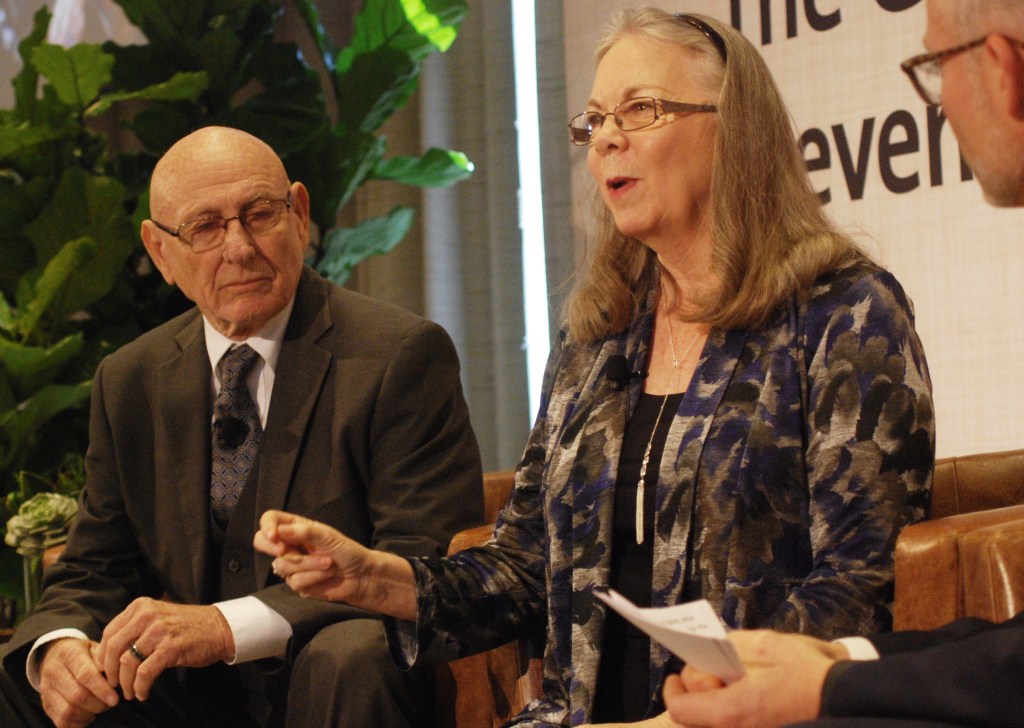
Ghawi had survived a mass shooting in Toronto in June 2012, only to be killed seven weeks later, they said.
The couple were among 26 speakers at the intense morning-long seminar in Manhattan, convened to gather support for a nationwide coalition of health care providers that will work to reduce gun violence.
The Phillipses, who started the nonprofit foundation Survivors Empowered, held hands as they spoke plainly, deliberately. They were there, they said, to advocate for the survivors of mass shootings.
“We see their pain,” Sandy said. “We see their daily struggles.”
For more, click here.
The future of suburbia
I was proud to serve on the media panel at Vision Long Island’s Smart Growth Summit last week. This Herald Community Newspapers editorial emerged out of that conference, which is always informative and inspirational:
Transforming the Hub will take political leadership
“What does the future of the suburbs look like?”
That was the question pondered by Rebecca D’Eloia, RXR Realty’s vice president for development and the project manager overseeing transformation of the Nassau County Hub, last Friday afternoon.
She was speaking before an audience of more than 1,000 people at the nonprofit Vision Long Island’s Smart Growth Summit, and all of them were eager to hear her answer. If RXR and its partner, BSE Global, succeed in remaking the Hub — the 72 acres surrounding Nassau Veterans Memorial Coliseum — it will look very different than it does now, D’Eloia made clear.
She outlined plans for a massive $1.5 billion project that would create a new mixed-use neighborhood with three distinct areas — a Sports and Entertainment District, an Innovation District and a Town Center. D’Eloia’s presentation was at once informational and uplifting. It gave us the sense that the acres of asphalt that now lie idle most of the time, except for the few hours during a game or event at the Coliseum, will at long last be put to good use and help propel the county forward.
For more, click here.
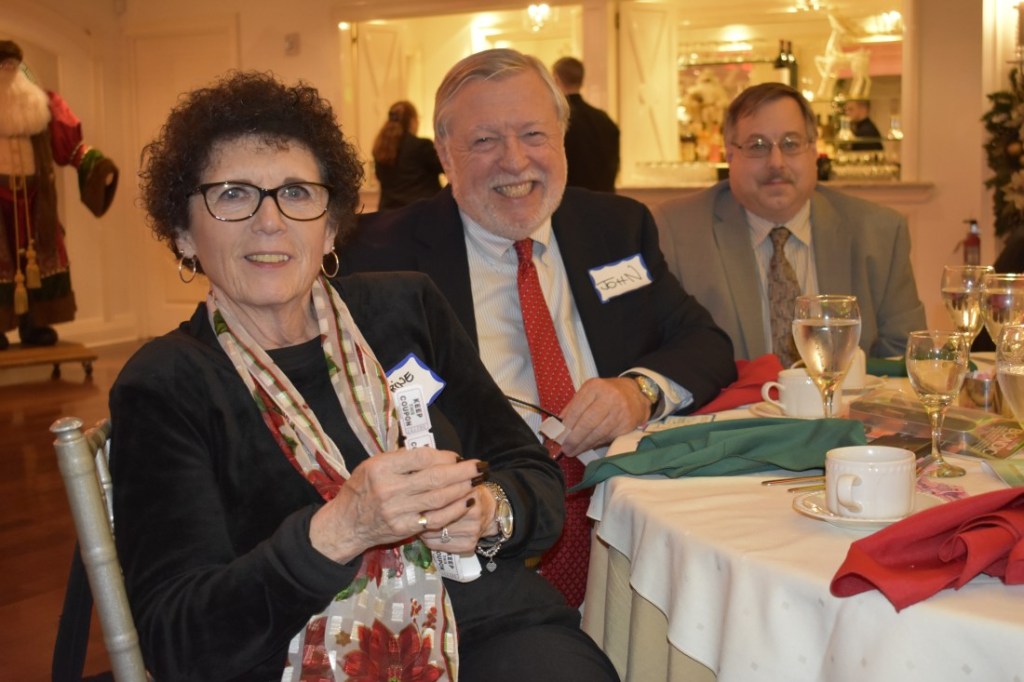
Everyone had a blast at the Press Club Holiday Party
Everyone had an awesome time at the Press Club of Long Island’s annual Holiday Party to raise money for scholarships for high school and college journalism students. Only sorry I couldn’t be there as I was teaching. Check out our pics from the evening: http://bit.ly/2PbQ6Mt @PCLI #PCLI
The inherent right of trees to exist
In my latest LIHerald.com column, I look at how Nassau County can save its remaining trees….
Posted December 5, 2019
By Scott Brinton
It was around 8 a.m. on a Saturday, if I remember correctly. The chainsaw revved, then wailed, as it tore into the old oak tree in the far corner of my neighbor’s yard. First, this fine specimen’s long branches were felled. Then its wide trunk was split in half. Finally, the lower torso was cut down, leaving only a stump.

It was a vibrant oak that had stood for half a century or more, by my estimation — oaks grow about a foot a year, and this one was roughly 50 feet tall. But there it was, this mighty tree, dead and gone in a matter of hours.
My neighbor, who sold and moved shortly afterward, had already removed all of the other trees and bushes in his backyard, leaving only a grassy plain measuring 1/32 of an acre. The oak was the tallest and most majestic of the lot.
I’m an ardent dendrophile — lover of trees — and my stomach was knotted as I listened to the oak come down section by section, as if dying a slow death by a hundred stab wounds. This was more than a decade ago; I forget the precise year. But I remember the bright sun and the whine of the chainsaw.
For more, click here.

